Airbrush Compressor Kit Comparison: Quiet, Stable Air for Models
10th Sep•10 min read
There is no supported universal winner here. Choose the Viair 400P RV for the longest reach and dual-wheel-oriented access, the Viair 300P for lighter, more compact storage, or the ARB CKMP12 for its higher published duty-cycle rating.
Important: Free-flow CFM and maximum PSI do not establish RV-tire fill time or the correct tire pressure for your vehicle. No common independent test supports a speed, value, or overall-best ranking.
The best portable air compressors for RV and van tires are not identified by a big PSI number or a free-air CFM headline. What matters is whether the kit reaches every valve, works within the vehicle's 12V electrical limits, and has a duty-cycle rating that fits the amount of airing you actually do. In this 12V tire inflator comparison, the Viair 400P RV, Viair 300P, and ARB CKMP12 each make sense for a different set of constraints, but the published data do not support naming one universal winner.
Show me CFM at 90 psi, not brochures.
That figure is not available consistently across these three kits, so this comparison stays honest: it emphasizes published high-pressure duty cycle, power demand, hose reach, physical size, and tire-access hardware. At working pressure, here's the story.
Here is the practical selection logic from the available manufacturer specifications:
All three are 12V portable units. The Viair models list a 150-PSI maximum working pressure and a 33% duty cycle at 100 PSI. ARB publishes a 50% duty cycle, defined as 30 minutes per hour, under laboratory conditions at 72°F. For a closer look at how ambient temperature can change compressor performance and maintenance needs, see this guide to air compressor CFM in hot and cold climates.
That is a meaningful runtime distinction on paper, but it is not a measured RV tire-fill comparison. There are no equal-condition fill tests here: no shared tire size, start and end pressure, ambient temperature, battery state, or voltage-at-the-compressor record. A larger zero-PSI CFM figure does not settle the question.
The Viair 400P RV Automatic Portable Compressor is the most purpose-configured choice of this group for awkward RV valve access. Its published 30-foot primary hose plus 30-foot extension is the longest supplied reach here. The kit also includes a gas-station-style inflation gun with a 160-PSI gauge, a 45-degree extended-reach chuck, and a 90-degree twist-on chuck. Those inflation hardware details are more useful than a generic "RV ready" label when you have inner dual-wheel valves or simply do not want to move the compressor around the vehicle.
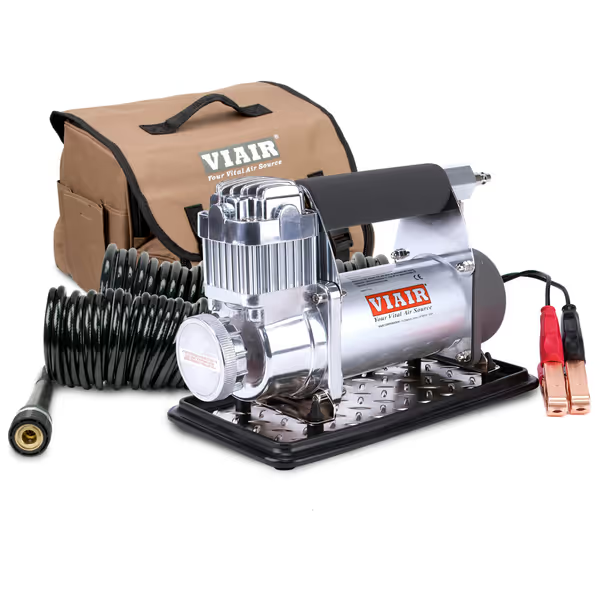
Viair also claims the 400P RV inflates a 275/80/22.5 tire from 80 to 90 PSI in under three minutes. Treat that as a manufacturer claim, not a test result to compare against the other two kits: the available information does not provide the ambient temperature, battery condition, or repeatability method.
The real decision point is not the 2.30-CFM free-flow number. RV tires are filled at substantial pressure, and airflow falls as back pressure rises. For an owner who routinely performs a modest top-off, the 33% duty rating may be entirely workable. For an owner airing several large tires after pressure changes, the required rest periods deserve as much attention as the inflation hardware.
A 30-amp maximum draw makes it important to confirm that your vehicle's connection method can support the load. Check your own vehicle's connection method and keep the leads and terminals clean and secure.
The Viair 300P Portable Compressor shares the 12V, 150-PSI, 33%-at-100-PSI, and 30-amp published specifications of the 400P RV, but it is physically smaller and lighter. At 8.70 pounds and 9.0 × 4.9 × 7.5 inches, it is the easiest of the two Viair kits to dedicate to a van drawer, recovery bin, or behind-seat compartment.
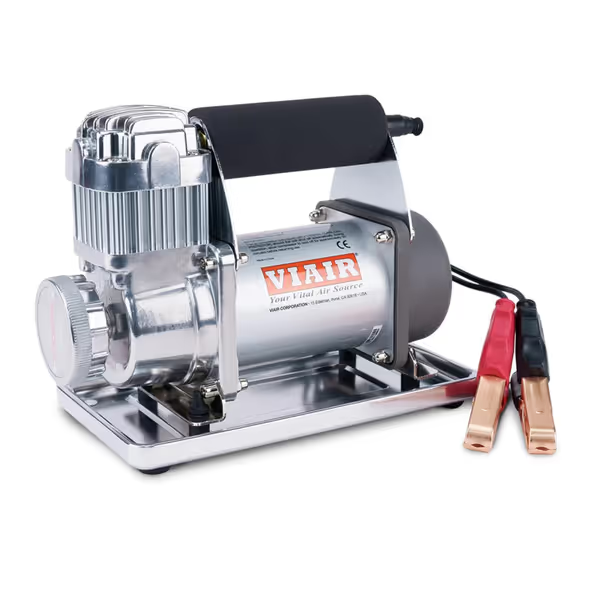
The 300P includes a 25-foot 5-in-1 inflator/deflator hose with an inline 100-PSI gauge. That interface can be convenient for tire-pressure adjustments, while the smaller package makes it attractive among portable car air compressors that need to stay out of the way until needed.
Its published numbers are:
Viair states that the 300P can inflate tires up to 33 inches. That is useful boundary information for many vans, trucks, Jeeps, and SUVs. It is not a blanket answer to "Is this the best air compressor for RV tires?" Tire diameter does not reveal tire air volume, required inflation pressure, axle load, wheel arrangement, or whether the hose and chuck can comfortably reach every valve on your rig.
The 300P and 400P RV have the same published free-flow CFM, duty cycle, maximum working pressure, and maximum amp draw. The substantive published differences are package size and weight, hose reach, and inflation hardware. If the 300P's 25-foot hose reaches every tire without straining the connection, its smaller footprint is a clear storage advantage. If you have dual rear wheels or need more reach around a larger coach, the 400P RV's supplied hoses and chucks are the more relevant differentiators.
The ARB Portable Compressor Kit CKMP12 is the most explicit of the three about its published high-pressure electrical draw and runtime conditions. ARB lists 32 amps at 100 PSI and a 50% duty cycle (30 minutes per hour) recorded under laboratory conditions at 22°C/72°F. It also publishes airflow at more than one pressure: 2.65 CFM at 0 PSI and 2.18 CFM at 29 PSI, both under those laboratory conditions.
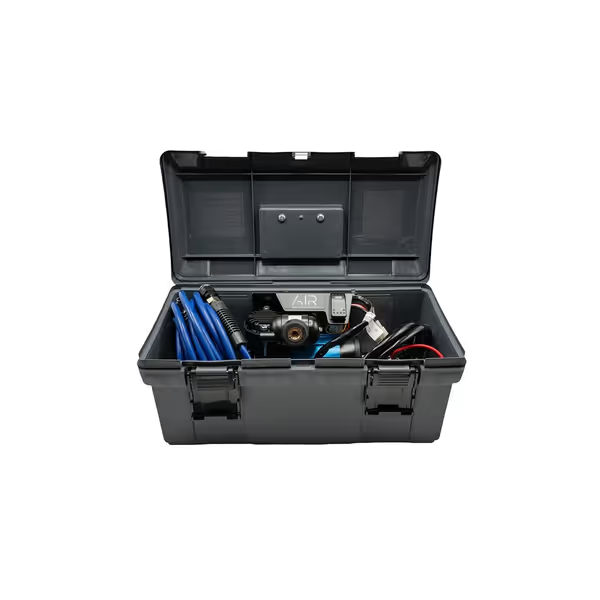
That extra 29-PSI data point is better context than a zero-pressure-only number, but it still is not CFM at RV tire pressure. It cannot be converted into a proven fill time for a large RV tire.
The trade is straightforward: this is the largest and heaviest kit in the group, with the shortest supplied hose, but it carries the strongest published duty-cycle specification. For a van build where runtime matters more than the smallest possible storage footprint, that specification may justify the size.
ARB's operating guide calls for connecting the alligator clamps directly to the corresponding 12V battery terminals with the switch off before connecting. It also advises leaving the vehicle idling in a well-ventilated area for maximum performance and to avoid depleting the battery. Follow the supplied operating instructions rather than improvising a low-current accessory-outlet setup for a 32-amp load.
| Compressor kit | Duty cycle | Published power draw | Hose supplied | Weight | Published pressure/flow information |
|---|---|---|---|---|---|
| Viair 400P RV | 33% at 100 PSI | 30A maximum | 30 ft primary + 30 ft extension | 10.75 lb | 150-PSI maximum working pressure; 2.30 CFM at 0 PSI |
| Viair 300P | 33% at 100 PSI | 30A maximum | 25 ft | 8.70 lb | 150-PSI maximum working pressure; 2.30 CFM at 0 PSI |
| ARB CKMP12 | 50% (30 min/hour) at 72°F | 32A at 100 PSI | 20 ft | 14.3 lb | 2.65 CFM at 0 PSI; 2.18 CFM at 29 PSI, both at 72°F |
Do not turn this table into a speed ranking. The current figures are not published under a common protocol, and only ARB provides a 29-PSI airflow figure. Measured inflation time needs a controlled tire, target pressure, ambient temperature, supply voltage, hose setup, and a record of amperage under load.
Measure from your planned compressor placement to the farthest tire. Account for a routed hose path, not a straight line through the RV. If you have dual rear wheels, inspect the valve geometry before choosing a chuck. The 400P RV includes a 45-degree chuck that Viair specifically describes for dual rear wheels.
A 150-PSI maximum working-pressure label does not tell you how quickly a compressor will add air near your tire's operating pressure. Duty cycle is the more actionable published guardrail in this comparison: 33% at 100 PSI for both Viair kits, versus 50% at 72°F for the ARB. Respect the specified operating schedule, particularly when topping off several tires. Following a maintenance schedule by compressor type and interval can also help preserve performance when the unit is used repeatedly for multi-tire top-offs.
These are high-current devices. The published figures range from 30 amps maximum for the Viair models to 32 amps at 100 PSI for the ARB. Voltage at the battery, cable condition, clamp contact, and any added connection resistance can affect the result. I have watched supposedly similar air systems lose their edge through restrictive fittings and poor flow paths; the same systems thinking applies to high-current 12V connections.
None of these products tells you what pressure your specific RV or van tires should run. ARB's manual gives the essential safety limit: do not inflate beyond the tire manufacturer's specified maximum pressure rating. Use the pressure guidance applicable to your tire, vehicle, and load; do not use the compressor's 150-PSI capability as a target.
Start with your tires' required pressure, total number of tires, valve access, and how much pressure you expect to add at one time. For these three kits, the published comparison is 150-PSI maximum working pressure and 33% duty cycle at 100 PSI for the two Viair models, versus ARB's published 50% duty cycle at 72°F and 32-amp draw at 100 PSI. The evidence does not establish a universal RV-size recommendation or comparable high-pressure fill times.
Do not exceed the tire manufacturer's specified maximum pressure rating. The correct target pressure for a particular RV depends on information beyond this comparison, so the compressor's maximum-pressure capability should never be used as your inflation recommendation.
This comparison cannot determine that. It does not provide a recommended pressure for a particular van, tire, or axle load. Use a gauge and inflator that let you adjust accurately once you have the applicable pressure guidance.
For a focused van life compressor review, the 300P is the compact-storage choice, provided its 25-foot hose and manufacturer-stated tire capability fit your vehicle. The 400P RV is the access-and-reach choice, particularly where its longer supplied hose arrangement and dual-wheel-oriented chuck solve a real service problem. The ARB CKMP12 is the published-duty-cycle choice, with a 50% laboratory rating and a clearly stated 32-amp-at-100-PSI figure, at the cost of more bulk and less supplied hose reach.
Before committing, map your farthest valve, confirm your tire-pressure requirement, and decide how many tires you may top off in one session. Then look beyond free-flow CFM. Further exploration should mean finding a test that records fill time at your own working pressure, along with ambient temperature, voltage at the compressor, hose ID, and amperage under load. That is the comparison data that turns a portable inflator into dependable RV or van equipment.