Tiny Home Air Compressor Guide For Quiet Off-Grid Use
23rd Aug•9 min read
The TIMBERTECH AS186 is the clearer choice when a documented 3 L receiver tank matters; choose the Master Airbrush Cool Runner II TC-320 when its listed 25 L/min airflow, dual cooling fans, and hose/holder package better match your setup. Neither is a proven overall winner because the available evidence is limited to seller specifications.
Important: Both 47 dB claims are seller specifications rather than controlled measurements, and the AS186 listing also gives a separate ≤50 dB figure.
An airbrush compressor kit comparison should start with the air you can document, not the paint job you hope to get. For model builders looking for the best airbrush compressor for models, the TIMBERTECH AS186 and Master Airbrush Cool Runner II TC-320 have similar headline claims, but their disclosed equipment is meaningfully different. The AS186 listing explicitly includes a 3 L receiver tank; the Cool Runner II listing emphasizes dual cooling fans, a 25 L/min airflow claim, and hose/holder accessories. Neither published listing supplies controlled tests for real pressure stability, moisture carryover, recovery, or sustained duty cycle, so there is no honest overall winner on performance alone.
This tutorial gives you a repeatable way to choose between them, set either one up without guessing, and identify what needs to be proven on your own bench before it earns a permanent spot beside your models.
The first rule is simple: a listed specification is a starting point, not a bench test. That matters especially with compact airbrush compressors, where airflow, noise, and continuous-running claims may not state the test conditions behind the number.
Here is the published-spec snapshot.
| Decision point | TIMBERTECH AS186 | Master Airbrush Cool Runner II TC-320 |
|---|---|---|
| Listed airflow | 20-23 L/min | 25 L/min |
| Disclosed pressure cycling | Starts at 3 bar / 43 PSI; stops at 4 bar / 58 PSI | Starts at 43 PSI; stops at 57 PSI |
| Pressure adjustment | Regulator with gauge listed | 0–57 PSI listed; regulator with gauge listed |
| Moisture component | Water trap and air filter listed | Water-trap filter listed |
| Tank | 3 L receiver tank explicitly listed | Storage-tank inclusion and capacity not established by the available listings |
| Cooling feature | Not established in the available listing | Single-piston unit with two built-in cooling fans listed |
| Noise claim | 47 dB in one listing field; ≤50 dB elsewhere | 47 dB |
| Accessories specifically listed | Compressor air-control/moisture components | Airbrush hose and holder for two airbrushes |
The airflow difference is only a nominal listing comparison: 20-23 L/min versus 25 L/min. Since neither figure comes with matching test conditions, do not translate that narrow difference into a promise of faster recovery or better spray behavior.
The same caution applies to hobby airbrush compressor noise. Both units are listed at 47 dB, but no measurement distance, operating state, or load is given. The AS186 listing also carries a separate ≤50 dB statement. Treat those as seller claims, not evidence that one machine will be quieter in your room.
Test before the pour. In model work, that means test before the color coat.
A compressed air tank is the clearest documented distinction in this comparison.
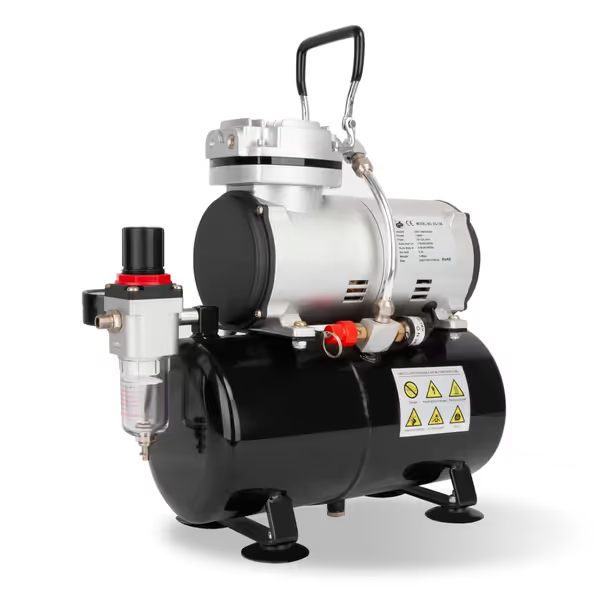
The TIMBERTECH AS186 is listed with a 3 L receiver tank, a regulator with gauge, water trap, and air filter. Its listed automatic cycle spans 43 PSI start to 58 PSI stop. The retailer also claims the receiver tank provides pulse-free output and constant airflow, but that is not independently tested evidence of pressure stability.
What you can say with confidence is narrower and more useful: if you want a compact model-airbrushing compressor whose listing explicitly identifies a receiver tank, the AS186 meets that documentation requirement. Its listing also claims compatibility with airbrush nozzle sizes from 0.2 to 0.8 mm.
The Master Airbrush Cool Runner II TC-320 listings reviewed here do not establish an included storage tank or a tank capacity. That is not proof that a tank is absent; it is a package-detail gap. If a receiver tank is central to how you want to work, verify the exact seller configuration before ordering rather than filling in the blank from product photos or naming conventions.
This distinction is where buyers get into trouble: they compare a known component against an assumed component. Keep those categories separate.
For models, clean and controllable air is the system goal. Both listings identify a regulator, gauge, and moisture-capturing component, which gives each a documented basis for controlled pressure adjustment and water collection.
In a Timbertech AS186 review, the supported takeaway is that the product listing includes:
That is a straightforward plumbing package on paper. Before you paint, inspect that the regulator responds consistently and that the water trap is empty. Do not modify the compressor or its air-control components to solve a cycling, pressure, or noise annoyance. For additional guidance on safe placement, ventilation, electrical requirements, and piping, see this air compressor installation guide.
The Master Airbrush Cool Runner II is listed with:
That hose-and-holder package is a practical included-accessory difference. It does not establish that an airbrush itself is included. Verify the complete package contents at the point of purchase, particularly if your plan assumes a brush, a tank, or a particular fitting is in the box.
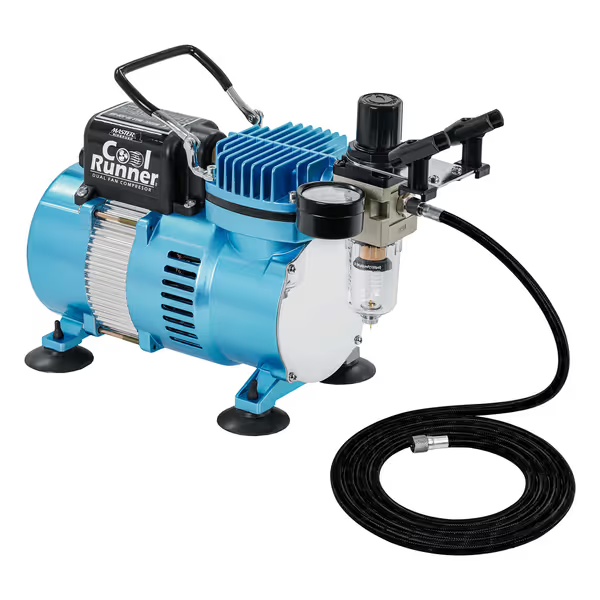
The Cool Runner II is listed as a 1/5 HP single-piston compressor with two built-in cooling fans. Its seller description says the fans support cooler, longer continuous running and a "long duty cycle". That is a design feature and a seller claim, not a numeric duty-cycle rating or an independently verified endurance result.
The AS186 listing does not provide a numeric duty-cycle rating in the available information either.
So use this decision logic:
Do not buy a compressor based on peak-looking language, then discover that its behavior during your actual painting session does not suit your process. If it trips a breaker at noon, it failed at dawn. The tabletop version of that lesson is less dramatic, but it still wastes a session: confirm the setup before the work that matters.
No listing-based comparison can replace a controlled check in your workspace. Keep the test simple and repeatable so you can compare the compressor against your own needs instead of someone else’s claims.
Record three notes: the pressure setting used, whether the compressor cycled during your normal spray pattern, and whether water appeared in the trap. Keep those records alongside a practical air compressor maintenance schedule so routine checks do not get overlooked. Those notes become your useful comparison data for future purchases or changes.
Here is the cleanest decision summary.
Neither option can be crowned the best airbrush compressor for models from the available specifications alone. There are no controlled comparison results for noise, pressure ripple, moisture handling, recovery, or endurance. The better purchase is the one whose documented configuration matches the way you intend to set up and test your air system.
There is no universal size answer supported by these listings. In this comparison, the AS186 is listed at 20-23 L/min with a 3 L receiver tank, while the TC-320 is listed at 25 L/min. Start by defining whether a documented tank, listed airflow, cooling feature, or included accessories matter most to your workflow.
The available product information does not establish a recommended model-painting PSI. It does show the AS186 automatically cycles between 43 and 58 PSI, while the TC-320 is listed with a 0–57 PSI adjustment range and 43/57 PSI automatic cycling. Use your paint and airbrush instructions to select a working setting, then verify it with the regulator and gauge before painting.
Write down your three non-negotiables: documented tank, published airflow, and included control/moisture hardware. If a tank is mandatory, verify the exact AS186 configuration. If dual fans and the hose/holder package matter more, verify the exact TC-320 configuration. Then run the preflight with test material before the model hits the bench. Reliable air is not a logo choice. It is a matched, checked system.