Quiet Cabinet Air Compressor Comparison: Real CFM And dB
21st Sep•10 min read
The California Air Tools 10020SPC is the strongest documented choice here for a small, low-to-moderate-demand clinic needing a quiet, enclosed, oil-free compressor—but it is not established as dental-certified or ready for direct clinical use. Its published 58 dB noise level and 5.30 CFM at 90 PSI are useful starting points, not independent test results.
Important: Oil-free pumping does not prove dental-ready air.
For buyers researching a quiet dental clinic compressor, the first correction is important: "oil-free" and "quiet" are necessary shopping filters, not proof that a unit is suitable for clinical dental air. The California Air Tools 10020SPC is the one cabinet-style option evaluated here. Its published 58 dB rating, oil-free dual-piston pump, and 5.30 CFM at 90 PSI make it worth a serious look for a carefully scoped small practice air system, but it is not established as dental-certified, medical-grade, or ready to connect directly to clinic equipment without separate validation of air quality, demand, and local requirements.
This is not a broad winner's list. With only one fully documented model, a fake comparison would be worse than no comparison. Instead, this is the purchase math: where the 10020SPC fits, where it does not, and what must be specified before calling any compressor a viable clinic system.
The California Air Tools 10020SPC is a 110 V, 2.0 HP, 10-gallon enclosed compressor built around an oil-free dual-piston pump. California Air Tools publishes 6.40 CFM at 40 PSI and 5.30 CFM at 90 PSI. For clinic planning, use the 90 PSI figure, not the larger 40 PSI number, unless every connected device is actually specified to operate at 40 PSI. Flow at working pressure is the number that decides whether equipment keeps up.
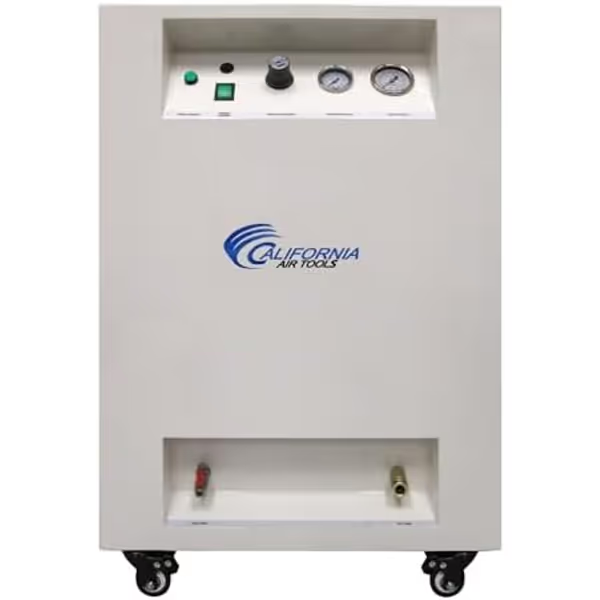
The manufacturer also lists:
| Decision point | Published specification | What it means in a clinic decision |
|---|---|---|
| Airflow | 5.30 CFM at 90 PSI | The useful starting number for matching actual equipment demand. |
| Noise | 58 dB | A manufacturer rating, not an independent sound test; still notably relevant where conversation and patient comfort matter. |
| Tank | 10-gallon steel tank | A listed feature to consider alongside the published airflow, fill-time, recovery, and demand figures. |
| Duty cycle | 70/30 | A stated limit that should prevent assumptions of all-day continuous operation. Test conditions are not defined in the available material. |
| Electrical requirement | 110 V / 60 Hz, 14 A low-amp draw | Plan a dedicated circuit as the owner's manual recommends; do not assume an already-loaded receptacle is adequate. |
| Cabinet | Soundproof cabinet, two latching doors, two exhaust fans | Helps address noise while making airflow and service access part of installation planning. |
| Footprint and weight | 19.75 × 19.75 × 31.5 in; 145 lb | Compact for a utility room, but not casually portable in the way a lightweight chairside compressor is. |
California Air Tools claims more than 3,000 hours before pump wear and listed a one-year limited warranty when this product information was collected; verify warranty terms at purchase. Treat the pump-life figure as a manufacturer claim rather than a lifecycle guarantee. A clinic's actual result will depend on run hours, heat, moisture management, maintenance, and whether the load stays inside the unit's duty-cycle envelope.
A sensible comparison is not against vague phrases such as "dental grade" or "ultra quiet". It is against the job the system must do: deliver sufficient air at the required pressure, within a sustainable run schedule, while maintaining an air-treatment chain appropriate to the equipment and practice.
At a manufacturer-stated 58 dB, the 10020SPC has a clear paper advantage for noise-sensitive locations compared with the typical expectation buyers have of open-frame compressors. The low 1,680-RPM motor and cabinet are designed around that goal, and the cabinet's two exhaust fans are intended to remove heat.
That does not mean "put it anywhere". The owner's manual calls for a flat surface with no more than a 15-degree incline and at least 2 feet of unobstructed space around and above the compressor. For additional guidance on electrical requirements, ventilation, placement, and piping, review this air compressor installation guide. The cabinet needs to reject heat; blocking it in to make it even quieter is the wrong kind of optimization.
Here is the space math using the manufacturer's 19.75-inch-square footprint:
That is roughly a 5.6-foot square service-and-ventilation zone, not a 20-inch-square closet installation. Measure the room before the purchase order, not after the cabinet arrives.
The 10020SPC's 5.30 CFM at 90 PSI is the number to place in your load worksheet. California Air Tools also states a 130-second fill from empty to full and a 40-second recovery from 100 to 130 PSI. Those are useful published benchmarks, but they do not substitute for a simultaneous-demand calculation at your equipment's actual pressure.
The listed 10-gallon tank should be assessed alongside the 5.30-CFM rating, published fill and recovery benchmarks, and the practice's documented demand. If demand repeatedly keeps the motor running beyond its intended cycle, heat and downtime become the hidden cost.
The manufacturer lists a 70/30 duty cycle, but the available documentation does not define the time window or operating conditions behind that notation. For preliminary planning only, a simple conservative screen is:
5.30 CFM at 90 PSI × 70% = 3.71 CFM
That 3.71-CFM figure is not a manufacturer-rated continuous output. It is a planning flag: if your documented simultaneous load is already near or above it, do not assume this compressor will carry the workload comfortably. Obtain each chair and device manufacturer's required pressure and flow, add only loads that can run at the same time, then include margin rather than sizing to a perfect spreadsheet tie.
This matters most when a practice has more than one active operatory or a device with a long, continuous air draw. A dental-equipment supplier notes that handpieces, air/water syringes, scalers, and air-abrasion equipment depend on steady, clean, dry air. The phrase to underline is steady. Average consumption is not the same as peak simultaneous demand.
The oil-free versus oil-lubricated dual-piston design is a real maintenance and contamination-control advantage compared with an oil-lubricated pump. But it is only one part of the system.
The available documentation does not show that the base 10020SPC includes:
California Air Tools lists a water/moisture and oil-separator filter and a refrigerated 98% air dryer as add-on options, not standard included equipment. More importantly, the owner's manual says air directly from the compressor or hose is not suitable for breathing. Do not translate "oil-free" into "patient-safe", "dental-ready", or "clean enough without treatment". Those are different claims.
For a dental application, confirm the required air-quality specification with the dental-unit manufacturer and the practice's applicable local and clinical requirements. Then specify the compressor, receiver, drains, filters, dryer, regulators, distribution line, and point-of-use components as one system. A quiet medical compressor is not a category label you can apply after adding a cabinet; it has to satisfy the actual equipment and compliance requirements of the installation.
The manufacturer specifies 110 V / 60 Hz and a 14 A low-amp draw. The owner's manual advises a dedicated circuit for best results and directs users to the serial label for voltage and amperage requirements. That makes circuit planning straightforward in principle: reserve the circuit, verify the installed receptacle and branch capacity, and avoid treating the compressor as one more plug-in load on a shared room circuit.
What cannot be assumed from the published 14 A figure is starting behavior on every existing circuit, extension cord, generator, inverter, or building wiring condition. If uninterrupted operation matters, have the electrical installation evaluated against the nameplate and the facility's actual circuit configuration.
The same skepticism applies to mobility. The 10020SPC has four swivel casters, so it can be rolled from one location to another. At 145 lb, however, this is a relocatable cabinet compressor, not an effortless chairside compressor or a product proven suitable for transport on a mobile dental cart. Plan it as a placed asset with a service path, ventilation room, and a stable, level floor.
Oil-free does not mean maintenance-free. Use a documented air compressor maintenance schedule to track draining, filter replacement, inspections, and service intervals. The published intervals and instructions support a simple maintenance plan:
No verified replacement-filter or service-part pricing is available here, so do not invent a maintenance budget from generic compressor parts. Price the actual filters, drainage hardware, air-treatment components, and qualified service support before comparing total ownership cost.
I have seen a shop celebrate a bargain compressor only to lose the savings in runtime, leakage, and electricity. The correction was not exotic: measure load, stop waste during idle hours, and buy capacity that actually matches duty. The same logic is even more important where interruption and air quality affect clinical equipment. Pay once for uptime, not forever for waste and noise.
The 10020SPC is a reasonable candidate for further specification when all of these statements are true:
It is a poor fit when the plan relies on any of the following assumptions:
It is the source of compressed air for equipment that may include high-speed handpieces, air/water syringes, scalers, and air-abrasion units. The system needs steady air delivery, while the required cleanliness, dryness, pressure, and flow must be confirmed for the specific equipment.
Oil-free systems are commonly relevant because clean, dry air is important in dental applications. But there is no single universal compressor configuration supported by the available information. Select the system against each device's documented requirements and the practice's applicable requirements; do not rely on "oil-free" as the full specification.
California Air Tools listed the 10020SPC at $1,444 when the product information was collected. That is the compressor price, not a complete dental-air-system budget. Dryer, filtration, drains, plumbing, electrical work, commissioning, and service can materially change installed cost, so verify current pricing and the complete scope before purchase.
California Air Tools claims more than 3,000 hours before wear for the oil-free dual-piston pump. That is not a promise of whole-system life or a guarantee of clinic service life. Duty cycle, heat management, draining, filtration, and workload determine whether that claim becomes useful uptime.
The California Air Tools 10020SPC is the strongest fit for a narrow scenario: a small, low-to-moderate-demand practice that needs a compact, cabinet-enclosed, oil-free compressor with a manufacturer-stated 58 dB noise level and whose documented peak load stays well inside 5.30 CFM at 90 PSI and the stated 70/30 duty cycle.
Its weak point is not necessarily the compressor, it is the leap buyers may make around it. This is not verified as a dental-certified system, and the base unit does not establish dental-ready air treatment or suitability for a particular number of operatories. Build the air-quality chain, calculate simultaneous demand, reserve the circuit, provide ventilation clearance, and verify local acceptance before purchase.
The right option is not the one with the quietest marketing line. It is the one that meets your documented working-pressure load for years, with controlled moisture, manageable maintenance, and no forced compromises on uptime.