Paintball Air Compressor Comparison: 4500 PSI HPA Fill
19th Aug•13 min read
The California Air Tools 10020SPC is the strongest choice when declared 90-PSI airflow matters: 5.30 CFM from a 10-gallon cabinet. Choose the 8010SPC for its lower stated noise claim, but its 90-PSI airflow listings conflict. The Metabo HPT EC28M is the portable, low-capacity option—not a cabinet equivalent.
Important: These are declared specifications, not independently measured CFM, dB, recovery, or timed performance.
A useful quiet cabinet air compressor comparison starts by separating what is declared from what is measured. For this comparison, useful missing evidence would include delivered CFM at the pressure your tool uses, recovery under load, and sound level measured at a stated distance. Those independently matched tests are not available for the three compressors covered here. What follows is a careful comparison of manufacturer-claimed and retailer-listed specifications (not a claim of real-world bench results).
Show me CFM at 90 psi, not brochures.
That distinction matters most in an indoor workspace compressor. A quiet unit that cannot sustain your demand only trades noise for waiting. Likewise, tank capacity is a separate specification to consider alongside declared airflow. At working pressure, here's the story.
It establishes three practical differences: format, declared air delivery at 90 PSI, and stated noise level. It does not establish which is genuinely quieter in your room, which recovers fastest, or which holds pressure best while a tool is running.
Why not? The available sound claims do not state a common measurement distance, operating state, room condition, or test protocol. A claimed 40 dBA, 58 dB, and 59 dB are useful shopping signals, but they are not a laboratory-grade decibel comparison. Without a shared test protocol and reported room conditions, these claims cannot predict what you will hear in a particular workspace.
The same restraint applies to airflow. Only two models have stable declared 90-PSI figures in the available information:
This is precisely where air systems get misdiagnosed. For a step-by-step method to match tool demand with compressor capacity, use this air compressor sizing guide before treating a low-flow problem as a compressor failure. For these three models, base the comparison on the declared working-pressure figures and avoid treating the 8010SPC's conflicting listing values as a settled sizing specification.
The California Air Tools 10020SPC is the clear declared-flow choice in this group. Its manual lists 5.30 CFM at 90 PSI, supported by a 10-gallon steel tank. The unit is listed at 21 × 26 × 32 inches and 129 pounds, with a soundproof cabinet, dual latching doors, two exhaust fans, and caster wheels. Its retailer-listed noise claim is 58 dB.
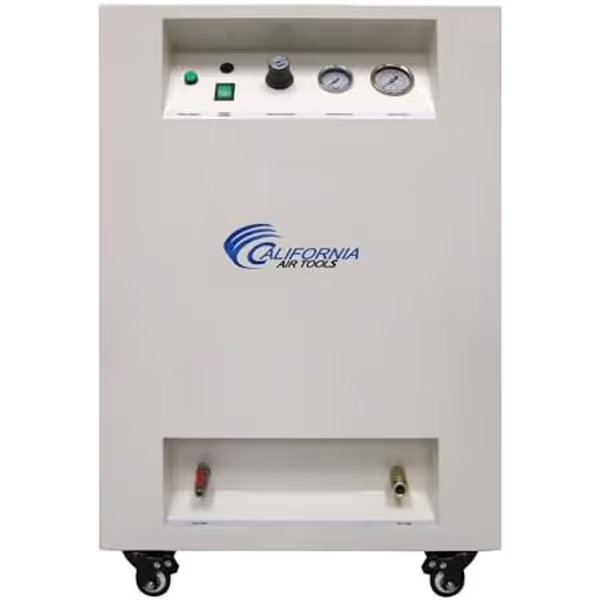
For a buyer whose work lives near 90 PSI, 5.30 declared CFM is the meaningful comparison point (not the 6.40 CFM figure at 40 PSI and not the tank size alone). The manual describes a pressure-switch range that shuts off at 145 to 150 PSI and restarts at 115 to 120 PSI. A retailer listing instead gives a 130-PSI maximum-pressure claim. Treat the current manual and the machine nameplate as the operating authority rather than blending those conflicting figures.
The important limitation: the collected information does not establish continuous performance for a DA sander, grinder, or spray setup. No timed tank-fill test, pressure-sag test, or independent recovery curve was collected for the 10020SPC. The manual also warns that use exceeding one hour continuously can overheat the motor; it does not provide a formal duty-cycle percentage.
Best fit from the documented specifications: a fixed or semi-mobile indoor shop that needs substantially more declared flow than a compact nailer compressor and can accommodate a cabinet roughly 32 inches tall. It is the strongest candidate here when declared 90-PSI capacity is the decision driver, but confirm your tool's consumption at its required pressure and leave margin before calling it a continuous-duty solution.
On stated noise alone, the California Air Tools 8010SPC carries the lowest claim: 40 dBA. For a broader comparison of quiet models and real-world decibel testing, see the quietest air compressors comparison. It is an 8-gallon cabinetized, oil-free unit listed at 21 × 20 × 32 inches and 125 pounds, with two latching doors and four caster wheels. Its manual says the pressure switch cuts power at 115 PSI and restarts at 85–90 PSI.
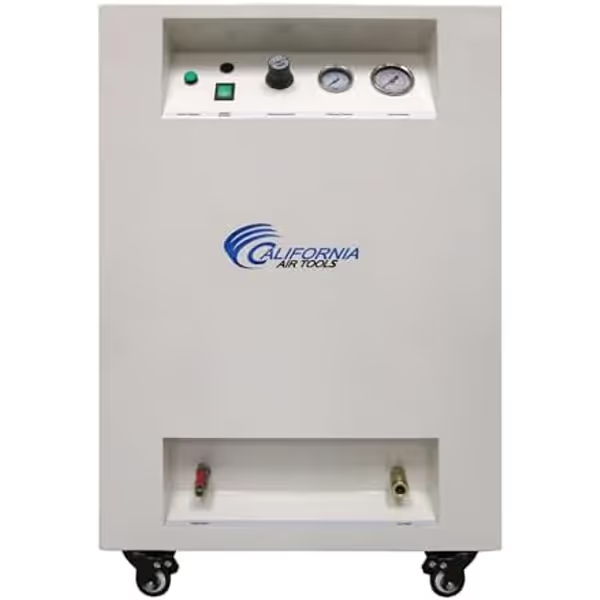
That 40-dBA claim may make the 8010SPC attractive where a lower stated sound level is the priority. But do not read it as a verified ranking over the 58-dB 10020SPC or 59-dB EC28M. No common test distance, A-weighted procedure beyond the 8010SPC's dBA label, room acoustics, or loaded operating condition was provided. The lower published number is a manufacturer claim reproduced by a retailer (not a measured winner's certificate).
Flow is the larger buying risk. The retailer page lists 3.10 CFM at 40 PSI, but its 90-PSI information conflicts internally: 2.20 CFM in one feature statement and 3.00 CFM in the description. That leaves no stable working-pressure rating for serious sizing. If the stated sound level and cabinet format are your priorities, that may guide the choice. If the task is flow-sensitive, pause the purchase decision until the 90-PSI number is clarified.
The 8010SPC manual also instructs a maximum of one hour of continuous operation followed by cooling time. That is enough to rule out casual assumptions about unrestricted all-day operation.
No. The Metabo HPT EC28M is valuable as a compact reference point, not as a like-for-like cabinetized compressor. It is a 1-gallon, hand-carried oil-free unit in a steel roll cage, measuring 14 × 14 × 13.5 inches and weighing 25.2 pounds. Its manufacturer claims 59 dB, 1.3 CFM at 40 PSI, and 0.8 CFM at 90 PSI. The pressure switch turns it on at 90 PSI and off at 125 PSI.
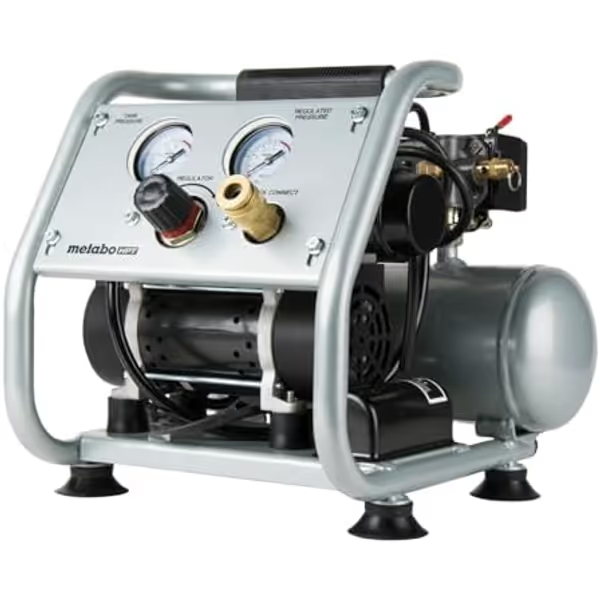
The EC28M's documented output and one-gallon tank distinguish it from the cabinet models. It is not documented as a soundproof air compressor, and its roll cage should not be confused with an acoustic cabinet. Its 0.8-CFM-at-90-PSI rating is the key number when matching it to a tool.
Best fit from the documented specifications: users who need a small, hand-carried indoor workspace compressor and can work within its stated 0.8-CFM-at-90-PSI figure. The cabinet models have considerably more tank volume, and the 10020SPC has far higher declared 90-PSI flow.
Use this decision order rather than starting with horsepower, peak PSI, or tank size:
Do not assume so. Both California Air Tools manuals require at least two feet of obstacle-free space around and above the compressor. An additional closet or DIY enclosure is not automatically safe under the available product information. General compressor installation guidance likewise emphasizes ventilation to avoid high-temperature shutdowns, but the product manual should control for that model.
For an indoor workspace compressor, plan the footprint with that clearance included. The cabinet dimensions are not the installed dimensions.
They can be, when lower stated noise and the required working-pressure airflow occur in the same unit. The tradeoff is visible here: the 8010SPC has the lowest stated sound claim but unresolved 90-PSI airflow; the 10020SPC has the highest documented declared flow but a higher stated noise figure. Value cannot be determined from these specifications alone because comparable measured noise, recovery, price, and long-term operating evidence are not available.
Not in the evidence reviewed here. These products are marketed as quiet, with stated claims from 40 dBA to 59 dB, but none is documented as silent.
There is no supported universal cutoff in the available material. For this comparison, the published claims are 40 dBA for the 8010SPC, 58 dB for the 10020SPC, and 59 dB for the EC28M. Because the test methods and distances are not supplied, use those figures as product claims, not as directly comparable room-noise measurements.
There is no universal best. The EC28M is the smallest documented option at 25.2 pounds with a 1-gallon tank, and it is rated at 0.8 CFM at 90 PSI. It makes sense when hand-carry portability is decisive; its documented format and declared capacity differ substantially from the cabinet units.
For this quiet cabinet air compressor comparison, the 10020SPC leads on consistently documented declared output at 90 PSI: 5.30 CFM. The 8010SPC leads on the lowest stated noise claim at 40 dBA, but its conflicting 90-PSI figures prevent a confident airflow ranking. The EC28M is a compact, quiet-claimed portable compressor, not a cabinet alternative, with a declared 0.8 CFM at 90 PSI.
Before you commit, map your tool demand at pressure and account for clearance and heat management where the compressor will live. Further exploration should focus on a current manual, a working-pressure airflow confirmation, and a noise reading taken at a stated distance in a space similar to yours. That is how a low noise compressor becomes a productive air system rather than a quiet source of downtime.