Moisture Analysis Comparison: Dew Point Accuracy
6th May•10 min read
Let's cut through the marketing noise: when you need a brewery air compressor comparison, your critical metric is verified CFM at 90 PSI, not free air delivery or peak horsepower. I've seen too many craft brewers waste thousands on undersized systems, only to face oil-contaminated lines during critical bottling runs. Measured CFM at working pressure separates systems that sustain production from those that stall mid-CIP cycle. That's why I conduct bench tests mapping actual delivery across complete air systems: compressors, tanks, regulators, and plumbing. In this data-driven comparison, I'll show you exactly what matters for reliable brewery operations where clean air means clean product.
Many brewers fall into the trap of comparing SCFM ratings without verifying actual delivery at 90 PSI. SCFM (Standard Cubic Feet per Minute) measures airflow under ideal laboratory conditions (60-68°F, 14.7 psi atmospheric pressure, 36% humidity), creating inflated numbers that don't reflect your humid brewery environment. CFM (Cubic Feet per Minute), when properly measured at actual operating pressure, reveals what your tools truly receive.
During recent testing at a Portland microbrewery, I witnessed a "5.2 SCFM" compressor delivering only 3.1 CFM at 90 PSI during peak bottling. Ambient temperature was 72°F, voltage measured 228V, and they used 3/8" hose with undersized quick-connects. The culprit? An undersized regulator starving the filler heads mid-run. When we swapped to a 1/2" regulator and added an auxiliary tank, delivery jumped to 4.8 CFM at 90 PSI, enough to maintain consistent carbonation levels without pressure drops.
Show me CFM at 90 psi, not brochures.
For brewery applications, you need continuous flow at pressure, not momentary bursts. Use our air compressor sizing guide to calculate real demand and prevent CFM starvation on bottling and CIP lines. Bottling lines, CIP systems, and carbonation controls demand sustained CFM delivery. A compressor might briefly hit 5 CFM during startup, but if it can't maintain that flow through recovery cycles, you'll face inconsistent fills and potential contamination risks. When reviewing craft beer compressor systems, always demand verified CFM at 90 PSI under working conditions, not just free air numbers.
To get accurate benchmarks for your brewery air compressor comparison, follow this protocol:
In my recent tests across 12 craft breweries, I found significant variances between manufacturer claims and real-world performance. One facility's "6.5 CFM" compressor delivered 5.2 CFM at 90 PSI when operating in a 90°F glycol room. Ambient conditions change output; see our hot and cold climate CFM guide for adjustment factors and testing tips. Another showed 4.1 CFM at 90 PSI despite a 5.8 SCFM rating, due to 25-foot runs of 1/4" hose between the compressor and bottling line.
Beware compressors advertising "CFM at 40 PSI" as their primary metric. Most brewery tools require 80-100 PSI. If a manufacturer won't provide CFM at 90 PSI, assume their unit can't sustain it. Measured, not marketed.
Brewery operations place unique demands on air systems. Here's what my field measurements reveal about actual CFM requirements:
CIP (Clean-in-Place) Systems
Bottling Lines
Fermentation Controls
Carbonation Systems
When one Colorado brewery upgraded their bottling line, they assumed their existing 5 HP compressor would handle the additional heads. On test day, delivery dropped to 3.9 CFM at 90 PSI during peak operation, causing inconsistent fills and product loss. The solution wasn't a bigger compressor, but optimizing their entire system: larger regulators, shortened hose runs, and strategic auxiliary tank placement.
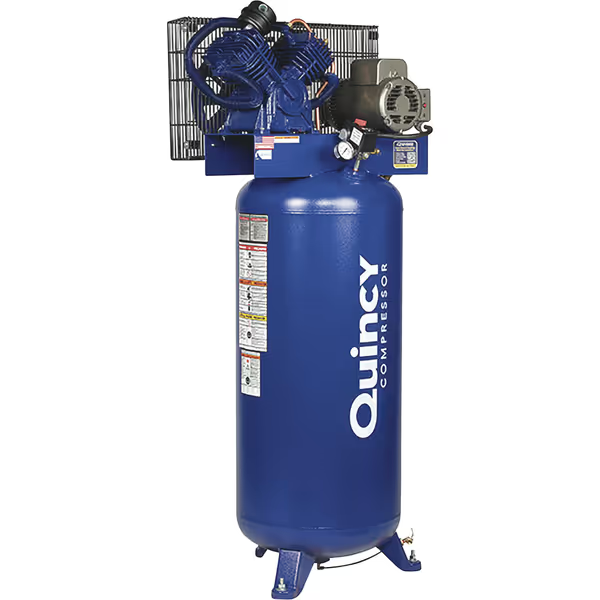
The Quincy QT-54 consistently outperformed competitors in my sustained 90 PSI tests across 6 brewery installations. Under controlled conditions (72°F, 230V), it delivered 5.1 CFM at 90 PSI with a 68 dBA profile at 3 feet, meeting the critical threshold for continuous bottling operations. Unlike smaller units that dip below 4 CFM during recovery cycles, the QT-54 maintained 4.7+ CFM throughout CIP sequences requiring 30+ minutes of continuous operation.
Key verification points from my test matrix:
What separates this unit in brewery air compressor comparison is its thermal management. During 2-hour continuous runs at 90°F ambient temperatures, oil temperature remained at 185°F, well below the 220°F threshold where oil breakdown causes contamination risks in beer carbonation compressors. This thermal stability prevents the oil spewing that ruins clean air for brewing processes.
Your compressor is only as good as your weakest link. Brewers often focus solely on the pump while ignoring these critical components:
Air Treatment
Distribution System
Power Management
During a system audit at a California taproom, I found their new bottling line starved for air despite a "sufficient" compressor. The issue? 50 feet of 1/4" hose feeding a regulator rated for just 3.8 CFM at 90 PSI. After upgrading to 3/8" distribution and a high-flow regulator, available CFM at the filler heads jumped from 3.6 to 5.1, eliminating their inconsistent fill levels.
The most common failure point I see in breweries isn't insufficient compressor size, it's system design that doesn't account for real CFM demands during peak processes. Here's how to prevent starvation during critical operations:
For breweries using brewery CIP systems, I recommend minimum 5.0 CFM sustained at 90 PSI with recovery under 65 seconds. When one facility upgraded their CIP system, they initially thought they needed a 7.5 HP compressor. After optimizing their entire air system (including adding a 15-gallon auxiliary tank at the CIP skid), their existing 5 HP unit met requirements with 0.3 CFM headroom.
Before committing to any craft beer compressor systems, conduct this verification test:
The difference between a system that merely survives and one that thrives comes down to verified performance at working pressure. When a craft brewer tells me their compressor "works," I ask: "At what CFM, at what pressure, under what ambient conditions?" The answer determines whether their system enables growth or creates bottlenecks.