
Compressor Consolidation ROI: Real Facility Case Study
10th May•13 min read
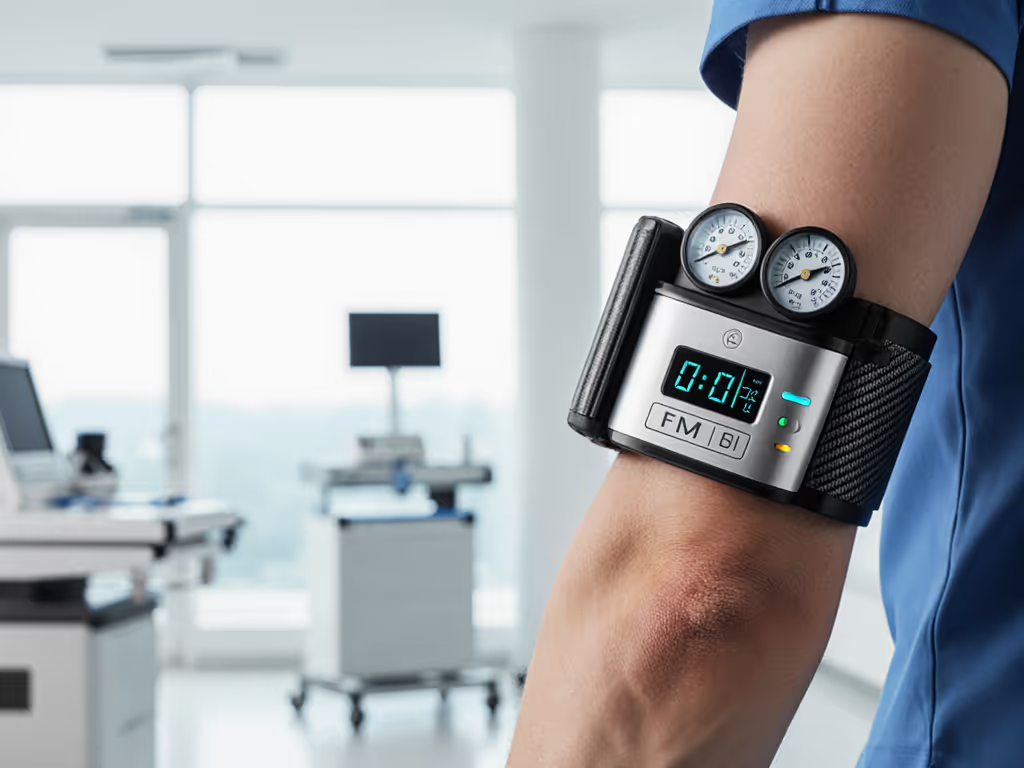
The wearable medical compressors category sits at an interesting intersection: portable air delivery systems are real, medical-grade systems exist, and market forecasts project explosive growth in wearable medical devices overall (including a 25.57% CAGR through 2035[1]). Yet when you dig into the specifics of compact, body-worn air or oxygen delivery systems engineered for clinical use, the product landscape remains sparse and test data even sparser.
As someone who has spent years on the bench measuring actual CFM at working pressure, recovery curves, and real-world duty cycles, I face a straightforward problem: measured, not marketed data on true wearable medical compressors is nearly nonexistent in published form. This article reflects what we know from market trends, where gaps exist, and why the distinction between marketing claims and verified performance matters more in the medical space than almost anywhere else.
The broader wearable medical devices market is expanding aggressively. The global wearable medical devices market reached USD 67.45 billion in 2026 and is projected to reach USD 523.58 billion by 2035[1], with some forecasts showing the market climbing to USD 505.28 billion by 2034[3]. These projections are anchored by proven product categories: continuous glucose monitors (CGMs), smartwatches with cardiac sensors, portable oxygen concentrators, insulin pumps, and diagnostic patches.
Within this ecosystem, portable medical devices that deliver compressed air or oxygen (particularly wearable oxygen systems and nascent micro-pump technology) represent a small but fast-growing segment. The clinical-grade wearable medical devices segment is identified as the fastest-growing by grade type[1], driven by accuracy requirements and remote patient monitoring needs.
However, true micro-compressor market data broken out specifically for wearable applications remains fragmented. Most "portable" compressors are still bench-top or cart-mounted units. Most wearable systems use battery-powered membrane or rotary vane technology rather than traditional piston or screw compressors. This distinction is critical and often blurred in marketing.
Here's what I've learned from years of testing compressed air systems across industrial and emerging medical applications: stated output specs almost never match delivery at the pressure where the tool or device actually works.
I once bench-tested two portable units marketed as delivering 5 CFM. For a clear primer on real output versus specs, see our CFM vs PSI guide. One pushed 3.2 CFM at 90 psi; the other, 4.8. The culprit wasn't brand reputation, it was undersized quick-connects and a restrictive integral regulator. For a hand-held sander or clinical diagnostic tool, that gap means stalling, incomplete cycles, or mission-critical failure.
In the wearable medical space, this problem is magnified. A portable oxygen system must deliver precise flow at the patient's prescribed pressure (often 5-10 psi for nasal cannula delivery). A micro-pump device might quote 10 LPM free-air flow but fail to sustain 5 LPM at the actual working pressure under thermal load. Battery drain accelerates under load, duty cycles collapse, and the device becomes unreliable.
Diagnostic & Monitoring Devices: This segment held 33.76% of the market share in 2026[3]. Most diagnostic wearables (ECG patches, glucose monitors, respiratory sensors) do not require compressed air. However, emerging spirometry patches and portable diagnostic devices may integrate micro-air delivery for sensor calibration or breath-actuated sampling.
Therapeutic Devices: The therapeutic device segment is the fastest-growing by product type[1]. Portable oxygen concentrators, nebulizer delivery systems, and CPAP blowers all rely on compressed air or oxygen generation. Many are moving toward wearable form factors (belt-worn, rucksack-integrated, or even implantable pump systems in development).
Clinical Grade vs. Consumer Grade: Clinical-grade devices are the fastest-growing segment[1]. This is the segment where verified CFM at pressure, recovery time, and failure rate data matter most, because patient safety and therapeutic efficacy depend on it. Consumer-grade wearable air devices (portable air pumps for inflatable supports, emergency responders' backup air) are more numerous but less rigorously tested in published benchmarks.
North America dominates the wearable medical devices market, holding 45.70% of global market share in 2025[3]. This region has the highest regulatory scrutiny, the most reimbursement infrastructure, and the strongest demand for portable, connected medical systems. The U.S. market alone is projected to reach USD 38.78 billion by 2026[3].
Asia Pacific is anticipated to record the highest CAGR during the forecast period[3], particularly in India, South Korea, and China. Remote patient monitoring solutions, growing smartphone penetration, and expanding healthcare infrastructure are driving adoption. This geographic trend suggests that wearable medical compressor designs optimized for low power draw and portability will see accelerated development in emerging markets.
Brazil and the MEA region are also highlighted as growth zones[1], driven by telemedicine adoption, home-based care, and rising chronic disease prevalence. In these markets, portable oxygen and air delivery systems that do not require centralized hospital infrastructure become particularly valuable. For home use cases and compliance basics, review home medical compressor standards.
The wearable medical devices market is growing at 20-25% CAGR[1][3], but the lack of standardized, public test protocols for portable compressor systems is a structural constraint. Here's why:
Regulatory Fragmentation: Medical devices are FDA-regulated in the U.S., CE-marked in Europe, and subject to different standards in each territory. For facility-side requirements, review hospital NFPA 99 air systems. A portable oxygen concentrator must meet ISO 24362 (among others), but micro-compressor components inside it may not have published performance curves at clinically relevant pressures.
Proprietary Integration: Most wearable medical devices are highly integrated (the compressor, pump, membrane, sensor, battery, and control firmware are bundled as a black box). Vendors rarely publish component-level CFM curves or thermal duty cycles. They publish system-level specs (e.g., "delivers 2 L/min at sea level for 4 hours"), which are real but don't map to the underlying compressor's actual performance envelope.
Variable Duty Cycles: Unlike stationary compressors that run at steady-state for extended periods, wearable systems operate in highly variable duty cycles, including burst delivery, on-demand actuation, and thermal throttling when the battery or pump heats up. This makes standardized bench testing at fixed pressure far less representative of real-world performance than it would be for a workshop compressor.
Safety and Liability: Clinical-grade wearables operate under strict liability frameworks. Vendors are incentivized to be conservative in their published specs and to avoid detailed disclosure of performance edges or failure modes that might invite comparison shopping or expose them to warranty claims.
Variable Speed Drive (VSD) Integration: Medical silent compressors in hospital settings already employ VSD motors to match output to demand, reducing energy waste[2]. This same technology is migrating into portable systems, with battery-powered VSD-like controllers that modulate pump speed based on patient demand or sensor feedback. For fundamentals and selection trade-offs, compare VSD vs fixed-speed compressors.
IoT and Remote Monitoring: Smart connectivity is becoming standard in clinical-grade wearables[2]. A portable oxygen concentrator can now report its internal pressure, battery state, filter saturation, and usage patterns to a clinician's dashboard. For architecture, sensors, and cloud data paths, see IoT compressor technology. This data transparency is crucial for reliability and early failure prediction.
Energy Efficiency Focus: Healthcare facilities and patients both demand lower power draw[2]. Micro-compressor designs optimized for efficiency (miniature diaphragm pumps, membrane compressors, and rotary vane units) are displacing older piston designs in portable medical air applications.
Smart Materials and Additive Manufacturing: Emerging compressor components (valve seats, pump housings, acoustic dampening structures) are being prototyped in advanced polymers and even 3D-printed biocompatible materials to reduce weight and enable body-worn form factors.
In my experience, the most dangerous compressor failures occur when stated specs do not match working conditions. In medical applications, the stakes are patient safety and therapeutic efficacy.
Consider a portable nebulizer pump rated at "10 LPM free air." Free air (atmospheric pressure) is a marketing metric. The nebulizer actually operates at 3-5 psi above atmospheric, the pressure required to atomize medication into a breath-inhalable mist. If the pump's true output at 5 psi is only 6 LPM, a 40% drop, the aerosol particle size distribution shifts, dose delivery per breath falls, and the therapy becomes subtherapeutic.
I have not seen published bench-test data from independent labs comparing leading wearable medical pump or compressor units at their actual working pressures. This is a critical gap. Until vendors publish or third-party labs establish standardized CFM-at-pressure, recovery time, and duty cycle data for wearable medical compressors, claims about performance and reliability remain unverified.
The wearable medical compressor category is primed for growth, but three factors will determine whether the market delivers on the 25% CAGR forecast[1]:
1. Standardized Testing and Transparency
Clinical-grade wearables need published CFM curves at clinically relevant pressures, thermal throttle thresholds, and battery-drain profiles under load. Until this data is available, procurement officers and clinicians will rely on anecdotal performance reports and vendor claims.
2. Form Factor and Integration Maturity
True body-worn compressors (fully integrated into textiles, implantable pumps, or modular cartridge systems) are still in prototype phase. Once these transition from R&D to manufacturing scale, the market will expand from the current cart-based and belt-worn devices into genuinely wearable territory.
3. Reimbursement and Regulatory Clarity
Portable oxygen and air delivery systems have reimbursement codes in most developed markets, but emerging form factors (implanted micro-pumps, smart textiles with integrated air delivery) face regulatory uncertainty. Once these are cleared and reimbursed, volume will follow.
The wearable medical compressors and micro-compressor market represent a nascent but fast-growing segment within the broader wearable medical devices ecosystem, which is projected to reach USD 523.58 billion by 2035[1] at a 25.57% CAGR[1]. Portable oxygen systems, nebulizers, and emerging body-worn therapeutic pumps are the primary near-term applications.
However, the category suffers from a critical gap: lack of published, standardized performance data at clinically relevant pressures. Vendors quote marketing specs (free air flow, rated pressure) but rarely disclose true CFM at the actual working pressures where devices operate, recovery times under thermal load, or duty cycle transparency.
For end users (clinical procurement teams, home health providers, and patients), this opacity creates risk. A portable oxygen pump that fails to deliver sustained flow at the prescribed pressure during a patient's active day is a therapeutic failure and a patient safety issue.
If you are evaluating a wearable medical compressor system or a portable device that relies on compressed air delivery, demand the data: CFM at your target working pressure (measured, not free-air), sustained duty cycle under thermal load, battery drain profile, and failure rate data from clinical deployments. Until that data is published, you are choosing on brand and marketing claims, not on performance.
The market will grow at 25% CAGR[1] because the clinical need is real. But reliability, safety, and therapeutic efficacy will only improve when vendors and third-party labs embrace the same rigor that established the industrial compressed air standard: measured, not marketed performance at the pressure that matters.