Compressed Air System Audit: Quantify Energy Waste & Savings
2nd May•9 min read
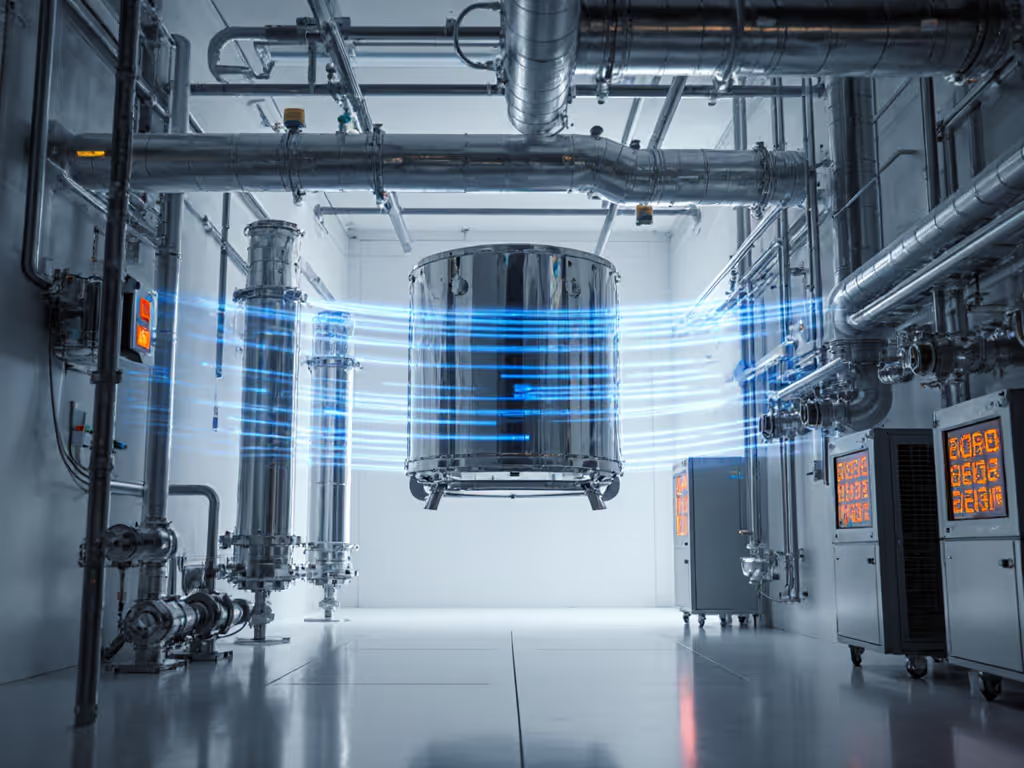
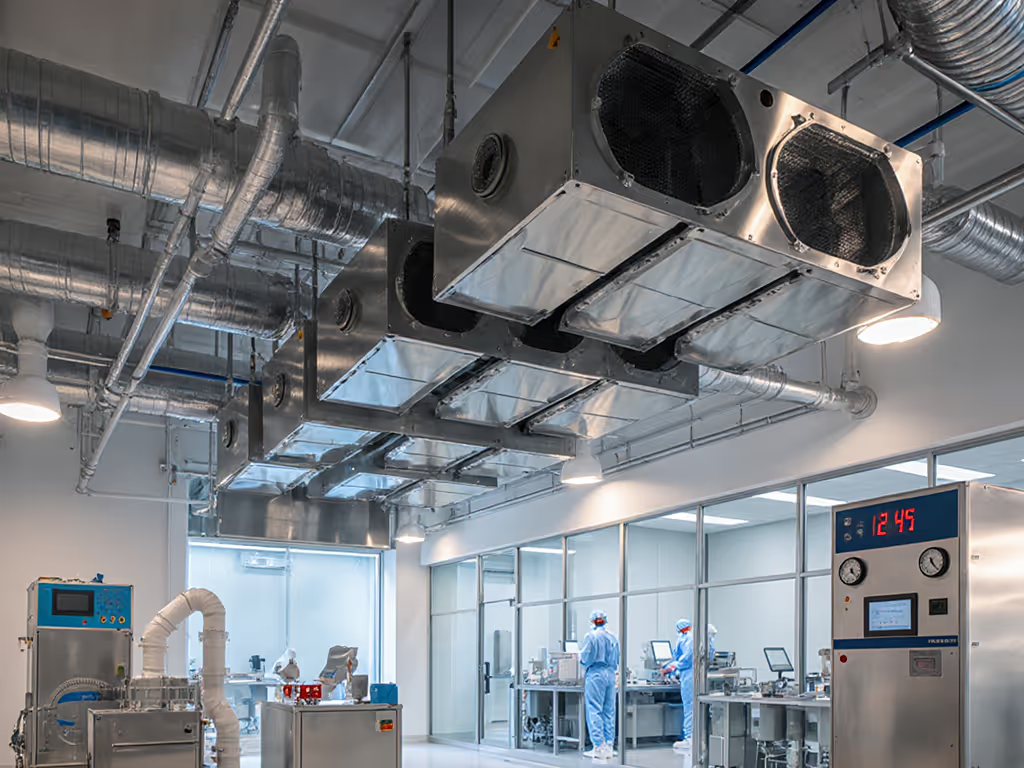
When designing facilities for quantum processors, the phrase 'quantum computing air requirements' transcends conventional HVAC concerns. We're discussing environments where air must approach near-perfect stillness at the nanometer scale (where even molecular movement can disrupt qubit coherence). These ultra-stable air systems represent the ultimate expression of precision environmental control, where vibration, particulates, and thermal fluctuations become critical failure points. I've measured countless industrial environments, but none demand the level of stability required by quantum processors. Quiet isn't just about comfort here; it's the foundation of computational integrity. For fundamentals on thermal management and vibration isolation that scale to high-stability rooms, see our compressor room design guide.
As someone who designs quieter shops with ventilated enclosures and isolation paths, I see quantum computing as the pinnacle of our field's principles scaled to extremes. The same vibration sensitivity that affects a cabinet shop's finish quality becomes existential for quantum states. A factory thought noise was 'just part of it' until we implemented thoughtful isolation; now imagine that shop dealing with quantum decoherence. The stakes are higher, but the physics remain interconnected.
Quantum processors operate in environments where thermal energy would overwhelm quantum states. While cryogenic cooling handles the extreme cold requirements, the surrounding air environment must maintain nanometer-level stability. Even minute air currents create thermal gradients and vibration that disrupt qubit coherence. I report A-weighted and unweighted dB at 1 m in conventional shops because psychoacoustic harshness affects human performance, but quantum facilities require measuring vibration down to picometer scales.
Recent industry measurements confirm that air movement exceeding 0.5 mm/s can introduce sufficient vibration to degrade quantum computation. This precision air stability isn't about temperature alone: it's about eliminating all forms of energy transfer that could collapse quantum states. In my work reducing shop noise, I've learned that vibration paths travel through floors and walls in unexpected ways. Quantum facilities must address these same pathways with even greater rigor.
Air vibration control for quantum systems operates at scales most engineers never consider. We're not measuring dBA anymore; we're tracking displacement in nanometers. Standard facility vibration criteria (VC curves) become inadequate when quantum processors require stability below 5 nm RMS across critical frequency bands.
The quietest shop I've designed achieved 38 dBA with careful isolation, but quantum facilities require vibration levels that would register as "background noise" on standard industrial accelerometers.
Specialized vibration isolation systems must address both airborne and structure-borne pathways. This includes:
My experience with floating compressors on isolation pads in shops translates to these extreme environments, just scaled by several orders of magnitude. The principle remains: break the vibration path or accept computational failure.
Nano-particulate filtration requirements for quantum facilities exceed even semiconductor cleanroom standards. For a baseline on industrial compressed air purity classes and how to hit them without overpaying, review ISO 8573 air purity. While Class 1 cleanrooms target particles ≥0.1 μm, quantum systems require elimination of particles down to molecular scale that could settle on sensitive components.
These facilities typically implement:
I note floor type, wall materials, and mounting specifications in every shop design because material choices affect vibration transmission and airborne particulates. Quantum facilities take this to extremes: every surface must contribute to the stable environment rather than introduce contaminants or vibration.
While quantum processors operate near absolute zero internally, the surrounding environment must maintain exceptional stability. Temperature fluctuations as small as 0.01°C can induce thermal drift affecting calibration. Humidity control must maintain <1% RH variation to prevent condensation risks near cryogenic systems. Selecting the right drying technology is critical—compare air dryer options for dew point and energy tradeoffs.
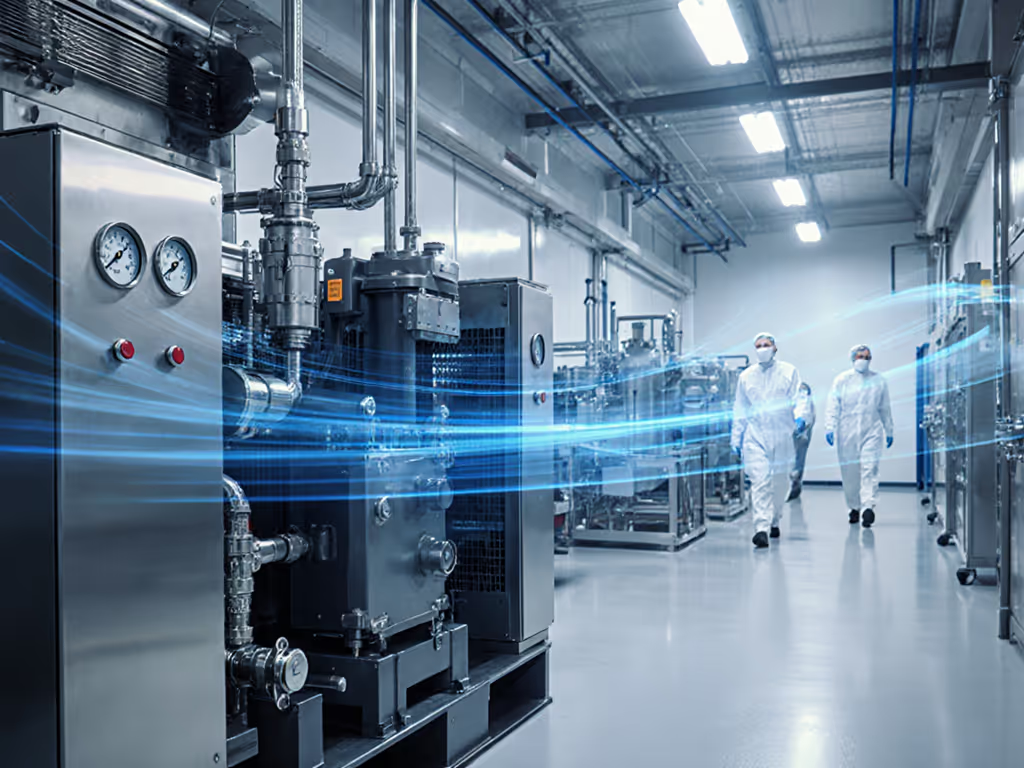
This creates a paradox: quantum facilities need robust ventilation to remove heat from supporting electronics while maintaining extraordinary air stability. Traditional HVAC approaches won't suffice; I specify airflow path and cooling clearance precisely in my shop designs, but quantum facilities require even more meticulous planning. The air must move sufficiently to manage heat loads yet remain stable enough not to disturb sensitive instruments.
This is where my mantra "Ventilate the quiet" applies most critically. Quantum facilities cannot use sealed environments; they generate significant waste heat from control electronics that must be managed. Yet conventional ventilation introduces unacceptable vibration and turbulence.
Successful implementations feature:
The cabinet shop that thought noise was inevitable taught me that perceived limitations often reflect inadequate solutions. Quantum facilities face similar challenges: "it can't be done" becomes "we haven't engineered it properly yet."
Quantum computing air requirements demand verification beyond standard facility metrics. For how sensors, data pipelines, and cloud analytics underpin high-resolution monitoring, see IoT compressor technology explained. I address psychoacoustic harshness, not just loudness in shops because human perception matters, but quantum facilities require instrumentation that measures:
These measurements must occur during actual operational conditions, not just during commissioning. The most sophisticated quantum facility becomes useless if its environment drifts during extended computations.
Designing for quantum computing air requirements pushes environmental control to its absolute limits. The same principles that reduce fatigue in workshops (meticulous vibration control, thoughtful airflow management, and precision environmental stability) become mission-critical at the quantum scale.
Quiet isn't luxury; it's throughput and focus you can hear. As quantum computing matures, facilities that master these ultra-stable air systems will outperform others through higher qubit coherence times and more reliable computation. The shops I design benefit from reduced errors and increased throughput; quantum facilities face the same equation, just with different variables.
For facility designers ready to explore these extreme environments, consider how your vibration isolation expertise, airflow management experience, and precision measurement capabilities can translate to this frontier. The principles remain consistent: you're just measuring quieter, smaller, and more critically than ever before.