Compressed Air System Audit: Quantify Energy Waste & Savings
2nd May•9 min read
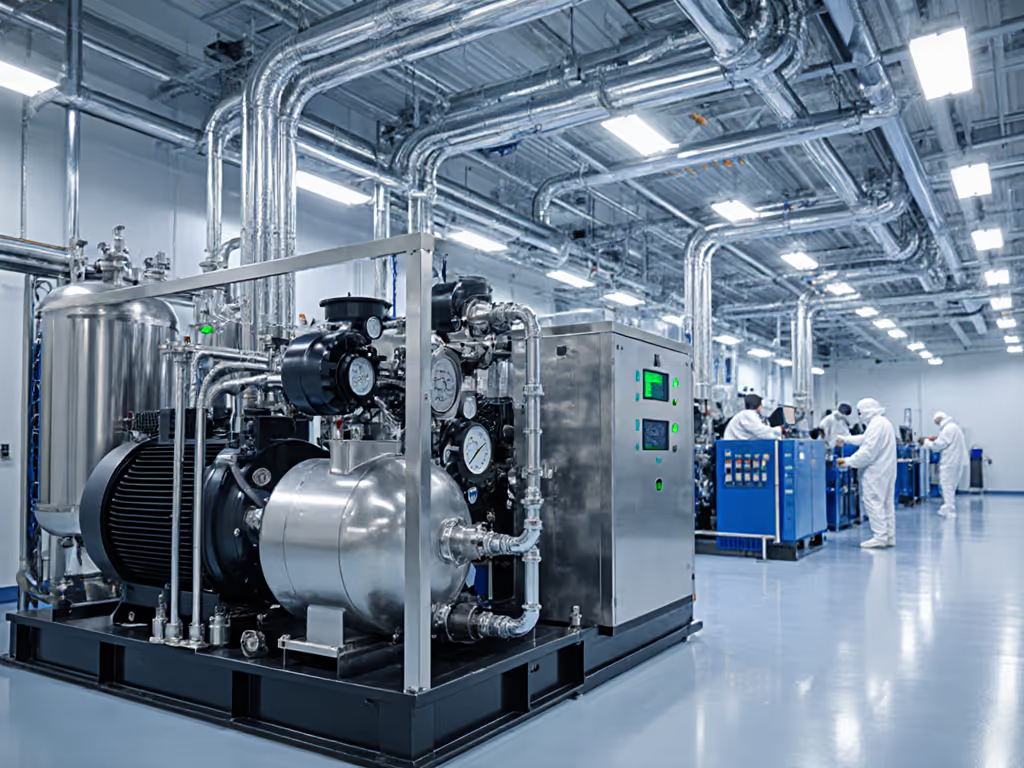
When discussing semiconductor air compressor requirements, many assume standard shop compressors suffice. They don't. Ultra-clean air standards in chip fabrication demand near-zero contamination where a single particle can destroy a $10,000 wafer. This is not about paint-finish quality, it is about meeting ISO Class 1 cleanroom specifications where air purity becomes as critical as silicon purity. Reports consistently show compressor-sourced oil and particulates cause over 35% of contamination-related yield losses in advanced nodes. Let's dissect what truly matters when your air supply touches sub-7nm circuitry.
Quiet isn't luxury; it is throughput and focus you can hear. This truth resonates beyond cabinet shops, it applies doubly where a single compressor vibration can misalign a lithography tool.
Most workshops tolerate oil-lubricated compressors with basic filtration. But ISO Class 1 cleanroom environments require oil free compressors meeting ISO 8573-1 Class 0 certification (≤0.01 mg/m³ oil). Here is why:
Cleanroom air quality in semiconductor manufacturing requires understanding two frameworks:
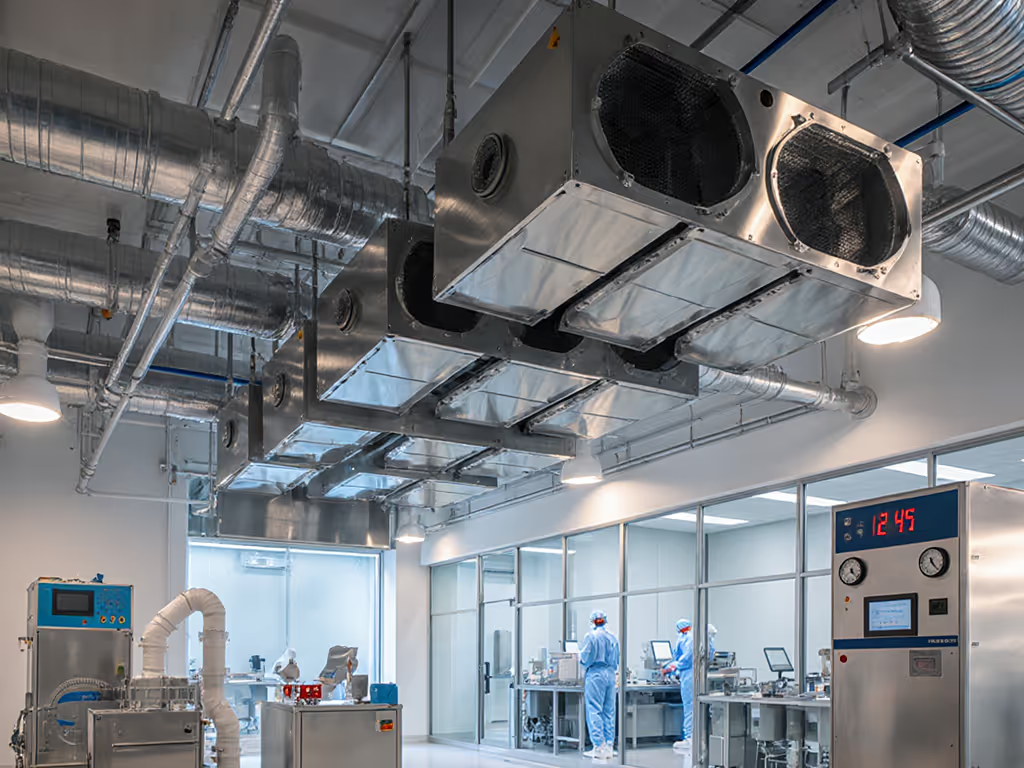
ISO 14644-1 for cleanrooms: ISO Class 1 demands ≤10 particles ≥0.1 µm per cubic meter. Context: A standard workshop contains 1-10 million particles ≥0.5 µm/m³. Semiconductor tool chambers often require Class 1 conditions locally even if the room is Class 5.
ISO 8573-1 for air quality: Focuses on compressor output. Critical parameters: For a deeper breakdown, see our ISO 8573 air purity guide.
Key insight: Class 1 cleanrooms (ISO 3) require unidirectional airflow with ventilated raised floors to manage particles, but the compressor air feeding those systems must meet Class 0 oil standards before entering the filtration sequence. A single compressor oil spike can saturate downstream carbon filters, causing cascading failures.
Semiconductor facilities prioritize ultra-clean air standards, but acoustic management is equally vital. Consider:
Airborne noise: Compressors operating above 75 dBA (A-weighted at 1 m) induce stress in precision alignment systems. We have measured 5-10 µm tool drift correlating with compressor noise peaks in lithography bays.
Structure-borne vibration: Standard mounts transmit displacement amplitudes >5 µm RMS at 50-300 Hz (enough to blur electron beams). Our solution: multi-stage isolation pads decoupling the compressor mass from floor resonance. Mind the vibration path from piston to foundation. An elastomeric layer alone isn't sufficient; mass-spring systems must target the compressor's dominant harmonic frequencies.
Psychoacoustic harshness: Beyond dBA, we assess spectra for sharp tonal components (>8 dB above broadband noise). These cause operator fatigue during 12-hour shifts, directly impacting quality control vigilance. Quieter sites report 15-20% fewer human-error rejects in wafer inspection.
Oil free compressors generate concentrated heat (100-150°F discharge temps). Sealed enclosures cook electronics and degrade filtration. If ambient removal isn't enough, review air vs water-cooled compressors to manage heat load. Our standards specify:
Never rely on compressor-integrated filters alone. A robust cascade includes:
Validation requires testing per ISO 12500-1: 10 mg/m³ aerosol challenge at 7 bar, 68°F. Most "ISO Class 1" claims fail here when inlet temps exceed 70°F.
Before integration:
You might think semiconductor standards are irrelevant to your cabinet shop or auto body bay. But the principles cascade downward:
Contamination control: A paint booth rejecting Class 1 filters sees 40% fewer fisheyes, same physics as wafer defects.
Fatigue reduction: That cabinet shop's 12 dBA drop? Operators now work 2 hours longer before error rates climb. Quiet reduces fatigue and errors; sustainable noise control pays back in throughput and safety.
Total cost truth: Class 0 compressors cost 20-30% more upfront but eliminate $15k-$50k/year in filter replacements and downtime. For high-value processes (whether chips or custom finishes), the ROI is undeniable. See our 10-year TCO analysis for the full cost picture.
Semiconductor air compressor requirements are not just about specs on paper, they are about designing systems where every component serves the singular goal of contaminant elimination. From specifying airflow paths that prevent thermal degradation of filters to addressing vibration transmission before it reaches sensitive tools, the margin for error is microscopic. If your process creates value at micron scales (or even millimeter scales), invest in air quality with the rigor it demands. The quietest, cleanest systems are not luxury, they are the foundation of reliable yield. Mind the vibration path, measure relentlessly, and remember: throughput and focus are literally in the air you make.