Compressor Consolidation ROI: Real Facility Case Study
10th May•13 min read
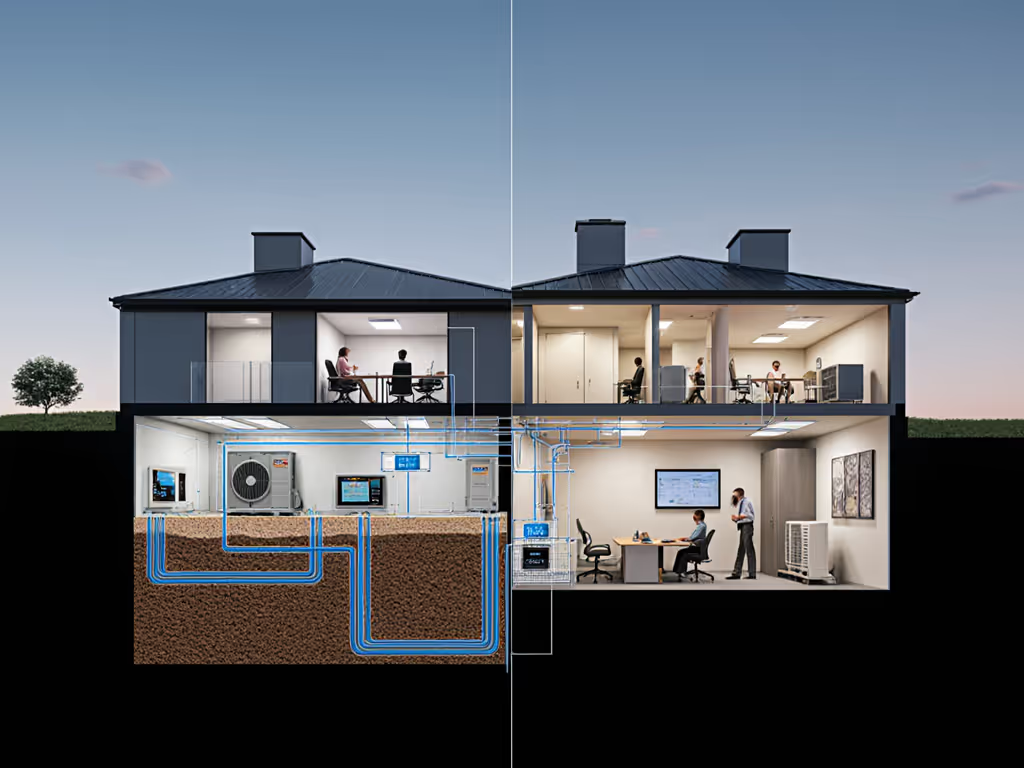
When commercial property owners face heating and cooling upgrades, the decision between geothermal compressor ROI and conventional HVAC systems typically hinges on one question: what does true ownership cost? This analysis compares both pathways (upfront capital, operating expense, maintenance burden, and the timeline to break-even), using standardized assumptions and verifiable data to cut through marketing claims.
Geothermal systems cost more to install. Ground loop drilling (vertical boreholes or horizontal loops) adds $10,000-$50,000 or more depending on site conditions and system size. A conventional air-source system or fossil-fuel HVAC may run 30-50% less upfront. That is real money, and property owners feel it immediately.
But here is where the spreadsheet tells a different story. Operating costs reveal the true economic divide.
Conventional commercial HVAC systems (whether air-source heat pumps or gas furnace + AC splits) carry predictable parasitic loads. A typical office building's space-conditioning source energy consumption can drop by roughly 50-70% when switching to ground source heat recovery systems[1][2]. For a parallel in compressed air, see how VSD vs fixed speed energy savings change lifecycle costs. That is not marginal; that is a fundamental shift in how buildings move thermal energy.
To illustrate with measurable terms: a 10,000-square-foot commercial space using conventional equipment might spend $15,000-$25,000 annually on heating and cooling[2]. A geothermal retrofit of the same building often reduces that to $7,500-$12,500 per year. The math compounds quickly. Over ten years, that differential alone ($75,000-$150,000 in avoided utility costs) swallows the upfront premium and generates profit.
Operating cost is only half the story. Thermal energy optimization depends on how intensively the system works and how long components endure under load.
Conventional equipment lives outdoors or in conditioned spaces subject to weather, humidity swings, and seasonal thermal stress. Compressors cycle on and off, each start drawing inrush current spikes. Outdoor condensers face freeze-thaw cycles, UV degradation, and salt spray corrosion in marine environments. Average lifespan: 10-15 years for well-maintained units, often less in harsh climates.
Geothermal systems place the compressor and most mechanical components indoors or underground, where temperature remains stable year-round. The ground loop operates in a relatively benign thermal environment, insulated from weather extremes. Component fatigue stress drops dramatically because cycling is gentler and less frequent. Documented lifespan: 25-50 years for ground-source systems versus 10-15 years for conventional equipment[1].
This longevity difference matters in total cost of ownership. A building owner comparing a $40,000 conventional retrofit lasting 12 years to a $60,000 geothermal retrofit lasting 30 years is not comparing a $40,000 system to a $60,000 system (it is comparing $40,000 × 2.5 cycles, three conventional replacements over 30 years, to one geothermal installation). The effective annual capital cost of the geothermal system is lower, even before accounting for operational savings.
Conventional HVAC requires seasonal service: refrigerant top-ups, compressor lubrication monitoring, condenser coil cleaning, fan motor inspection, ductwork filter changes. Outdoor equipment invites vandalism and debris damage. Indoor splits collect dust on coils. Annual maintenance costs typically run $500-$1,500 per system, plus emergency repair premiums when summer demand spikes or equipment fails unexpectedly.
Geothermal systems have fewer moving parts exposed to the elements. No outdoor condenser means no coil corrosion, fan blade degradation, or weather-related shutdowns. The ground loop, once installed and tested, requires virtually no maintenance (it is sealed, pressurized, and stable). Maintenance costs often drop to $300-$600 annually, primarily routine filter changes and refrigerant circuit inspections[2][3]. Emergency failures are rare because operating stresses are lower.
Pay once for uptime, not forever for waste and noise.
This is not marketing sentiment; it is the arithmetic of deferred capital and reduced emergency spending.
Federal policy now recognizes the commercial case. The DOE's 2025 "Pathways to Commercial Liftoff" report projects that national-scale geothermal deployment could save $300 billion in grid-service costs by 2050 and eliminate 433 million tonnes of CO2 annually[1]. For equipment planning under new rules, review the 2025 DOE compressor standards impact. More immediately, individual commercial properties see measurable ROI.
Scaling matters. Large office buildings, warehouse complexes, educational facilities, and government buildings achieve payback in 1-5 years when geothermal loops are financed or owned by utilities and recognized as distributed energy resources[1]. For capital planning parallels, see our air compressor financing options. Even without utility partnerships, standard commercial ROI calculations show payback within 5-10 years, with continued operational savings thereafter[2].
In high-energy-cost regions or climates with extreme seasonal heating or cooling demands, payback accelerates. Hospitals, data centers, and laboratory facilities (where uptime and consistent temperature control are non-negotiable) recover geothermal investment in 4-7 years while simultaneously reducing disruption risk[1][4].
Conventional systems, by contrast, rarely generate measurable ROI. Owners save on capital but accept higher running costs and shorter asset life; they break even only in scenarios with very low utility rates or minimal HVAC demand.
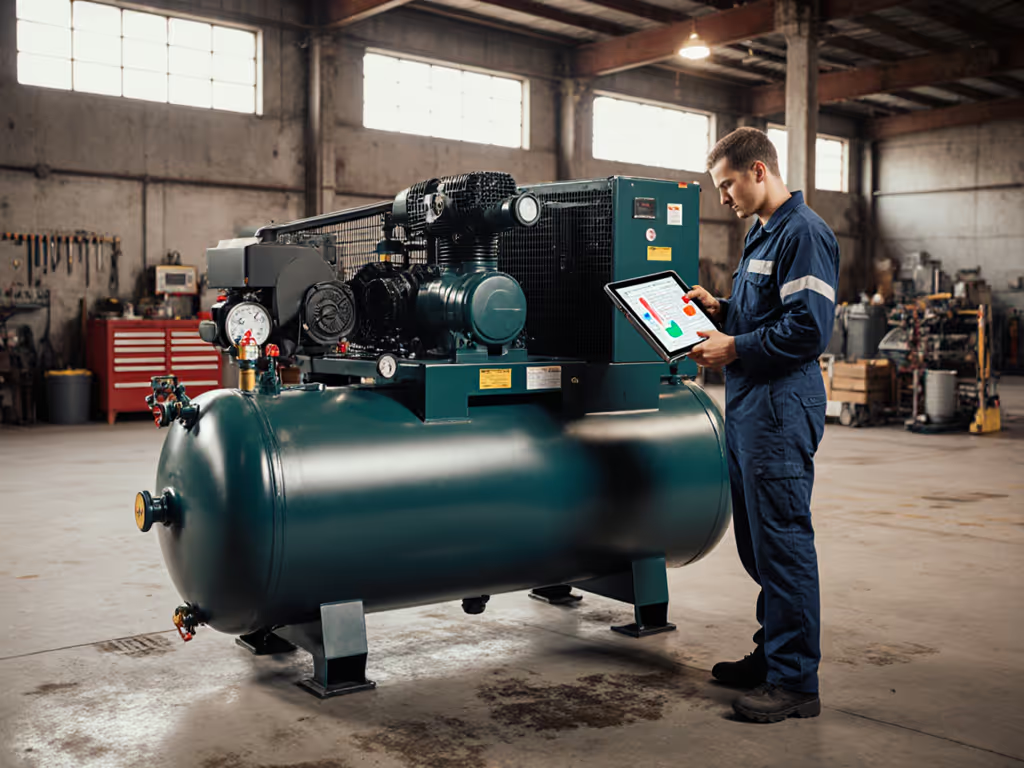
Years back, a cabinet shop owner chased a quick win: a heavily discounted used rotary screw compressor. The purchase price looked smart until the electric meter revealed the truth. The unit ran inefficiently, leaked, and wasted energy on poor maintenance. The owner mapped actual duty cycles, logged amperage at start and under load, and calculated annual energy waste (thousands of dollars). The solution was not a cheaper machine; it was the right machine: a properly sized two-stage system with auto-drain, nighttime shutoff, and scheduled maintenance. Payback took ten months. The lesson: fix leaks before upgrades. See the compressed air leak ROI calculation to understand why small losses destroy payback. In HVAC terms, that means audit existing waste before investing in new systems.
For commercial properties, the equivalent is a pre-retrofit energy audit. Understanding current heating and cooling consumption, peak demand hours, and zone-specific loads informs system sizing and reveals whether geothermal makes sense for that specific property. Not every building benefits equally; a lightly loaded office in a mild climate may not see the same ROI as a data center in a continental climate.
Geothermal systems do more than lower individual utility bills. They shrink building carbon footprint (greenhouse gas reductions up to 75% versus conventional HVAC)[4], enhance grid resilience by reducing peak demand, and qualify as non-wires or non-pipes alternatives for utilities, deferring costly infrastructure upgrades[1]. These indirect benefits create market value: properties with proven geothermal efficiency attract tenants prioritizing ESG goals, support corporate sustainability commitments, and command premium rents or faster lease rates[1].
Conventional systems offer no such collateral value. They meet code and provide comfort but do not signal operational excellence or environmental stewardship.
Geothermal installations require drilling expertise, geothermal HVAC integration with existing ductwork or radiant systems, and coordination between site conditions and loop design. A poor borehole layout, inadequate thermal conductivity in soil, or integration errors with existing infrastructure can inflate costs and reduce efficiency gains.
Conventional systems integrate faster and require less site-specific planning. Replacement-in-kind retrofits are straightforward. That speed advantage, however, is temporary; it front-loads the project but doesn't offset years of higher operating cost.
These payback models assume:
Sensitivity shifts the timeline: high-energy-cost regions see payback 2-3 years faster. Extreme climates (very cold winters, hot summers) compress the break-even window. Conversely, mild climates or properties with low heating/cooling demand extend payback, sometimes beyond acceptable thresholds.
Choose conventional HVAC if:
Choose geothermal if:
The decision between geothermal and conventional HVAC is not a choice between a more or less expensive system; it is a choice between different economic timelines. Conventional systems cost less initially but run expensive for their entire short life. Geothermal systems demand capital upfront but return that investment through lower operating costs, extended asset life, and reduced maintenance burden over a 25-50 year horizon.
For commercial property owners thinking in decades, the spreadsheet is clear: geothermal payback converges with conventional lifetime cost around year 5-10, then pulls sharply ahead. By year 15-20, the cumulative ownership cost of a geothermal system is often 40-60% lower than the cost of maintaining and replacing conventional equipment twice over.
The choice hinges on your ownership horizon, local energy costs, site conditions, and operational priorities. If your building must run reliably and efficiently for the long term, the math points toward ground source. If you are repositioning an asset for short-term resale, conventional equipment may suffice. But if you count true cost, not just sticker price, geothermal's case is compelling. Audit your current consumption, model your specific payback scenario, consult an energy engineer, and let the numbers guide your decision. That is how you avoid buying twice.