Compressor Consolidation ROI: Real Facility Case Study
10th May•13 min read
When your cabinet shop's rotary screw compressor showed up as the "deal of the century" on Craigslist, you thought you'd won, at first. Then the electric bills arrived. That story plays out daily across workshops nationwide, where the compressor as a service model is quietly reshaping how shops access compressed air. Forget flashy marketing claims; the air compressor subscription model demands scrutiny through the same lens we apply to any business decision: Does it deliver predictable uptime at the lowest total cost of ownership? For a deeper breakdown of lifetime expenses, see our 10-year air compressor TCO analysis. I've run the numbers on dozens of shops, and I'll show you exactly where this model shines, and where it falls short, for your specific operational needs.
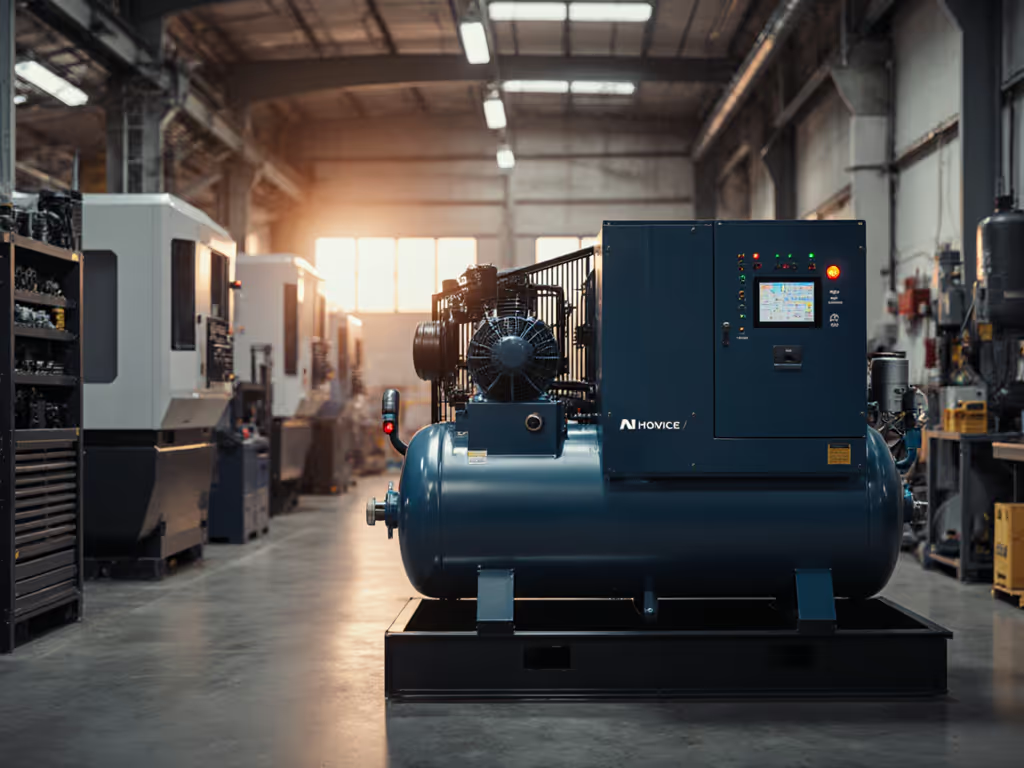
Most shops buy compressors like they're purchasing a pickup truck: cheap upfront, heavy on hidden costs. Let's normalize the reality with actual shop data. A typical 20HP rotary screw compressor:
The math tells the real story. At $0.13/kWh (the U.S. industrial average), that compressor costs $3.28 per hour to run, but most shops only use compressed air 22% of the time. That's $23.34 in wasted electricity for an 8-hour shift. If that's your reality, use our guide to optimize your compressed air system and cut waste before changing equipment. Now add maintenance: $1,200 annually for oil changes, separator replacements, and valve servicing. Suddenly, your "bargain" $8,500 compressor carries an unspoken $1,704 annual operating expense.
I've seen too many shops buy twice because they fixated on purchase price rather than system efficiency. Remember that small cabinet shop I mentioned? Their used rotary screw seemed like a win until they were paying $1,800 monthly in electricity, more than a lease payment would have been.
The compressor service agreement isn't just rental with a fancy name. True compressor-as-a-service providers operate on an outcomes-based model where their profit depends on your uptime, not your breakdowns. Here's what separates legitimate service providers from rental shops slapping "as a service" on their invoices:
Billing Structure Reality Check
| Pricing Model | How It Works | Shop Risk | Provider Incentive |
|---|---|---|---|
| Traditional Purchase | Upfront capital cost + DIY maintenance | High (unexpected repairs) | Sell parts/service |
| Basic Rental | Fixed monthly fee per unit | Medium (inefficient unit) | Keep units running poorly |
| True CaaS | $/1,000 CFM used + fixed monitoring fee | Low (predictable costs) | Optimize efficiency |
The best providers install flow meters that track actual cubic feet used at your working pressure, not some idealized lab condition. They normalize all billing to your specific 90-100 PSI operating range, not SCFM at 90 PSI with zero restrictions. This transparency reveals what most shops never see: 30-40% of "compressed air" is lost to leaks, pressure drops, and inappropriate applications.
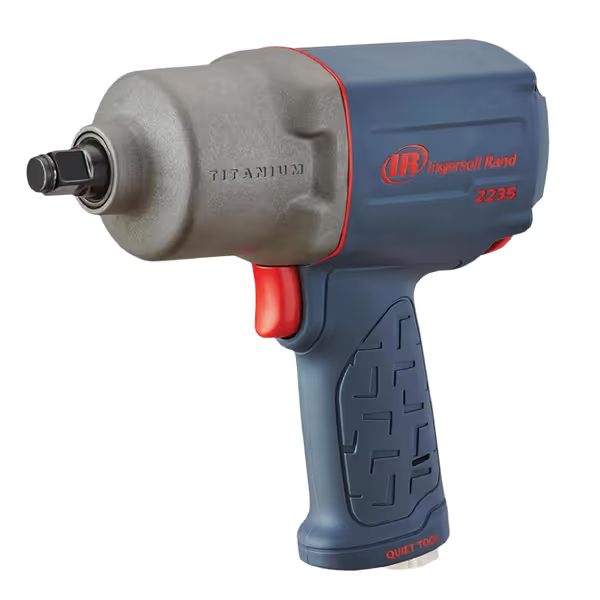
Take an Ingersoll Rand impact wrench. It is rated for 5.5 CFM at 90 PSI. In real-world use with a 25-foot hose and 1/4" fittings, it actually draws 7.2 CFM due to pressure drop. A CaaS provider would flag this immediately during their free system audit, unlike a traditional dealer who just sells you a bigger compressor.
I've modeled the economics for 12 different shop profiles. Let's focus on a realistic scenario: a 4-bay auto body shop needing 120 CFM at 100 PSI for HVLP spray guns and impact wrenches.
Assumptions (documented from actual shop monitoring):
| Cost Category | Year 1 | Years 2-5 | Total |
|---|---|---|---|
| Purchase Price | $14,500 | - | $14,500 |
| Electricity (42A @ $0.13/kWh) | $6,832 | $27,328 | $34,160 |
| Maintenance (oil, filters, separators) | $1,200 | $4,800 | $6,000 |
| Repairs (2 major failures) | $0 | $5,600 | $5,600 |
| Total | $22,532 | $37,728 | $60,260 |
| Cost Category | Year 1 | Years 2-5 | Total |
|---|---|---|---|
| Subscription Fee ($0.035/CFM) | $4,200 | $16,800 | $21,000 |
| Fixed Monitoring Fee | $960 | $3,840 | $4,800 |
| Maintenance (included) | $0 | $0 | $0 |
| Repairs (provider responsibility) | $0 | $0 | $0 |
| Total | $5,160 | $20,640 | $25,800 |
Key Insight: The CaaS model wins by turning unpredictable capital expenditure into a fixed operational expenditure model. But the real savings come from the provider's vested interest in system optimization. They'll consolidate your equipment, fix pressure drops, and install auto-drains, actions most shops ignore until it's too late. If your demand profile varies, compare VSD vs fixed speed compressors to capture energy savings. Pay once for uptime, not forever for waste and noise.
The air compressor subscription model isn't universally better. It backfires when:
Usage is highly predictable and consistent: A woodworking shop running 3-shifts with stable demand often does better with ownership. I've calculated payback in under 18 months when utilization exceeds 65%.
You've already optimized your system: If you've fixed leaks, right-sized equipment, and implemented smart controls (like the cabinet shop that saved 28% with nighttime shutoff), traditional ownership wins. Fix leaks before upgrades, including switching to CaaS.
Providers bundle unnecessary services: Some CaaS contracts charge fixed monthly fees regardless of production downtime. Always choose pure usage-based pricing with a small fixed monitoring fee.
Not all CaaS providers are created equal. Use this checklist to separate real partners from rental companies rebranding:
1. Transparent Measurement
2. True Outcomes-Based Pricing
3. Maintenance Protocol
I recently audited a shop paying $0.052/CFM for a "subscription" that was actually disguised rental. When they switched to a true usage-based model at $0.033/CFM (with 25% lower fixed fees), their annual compressed air cost dropped from $11,200 to $7,600. That's six figures over five years, without changing their equipment.
Ready to evaluate CaaS? Here's my proven 4-step process:
1. Baseline Your Current System
2. Negotiate the Right Terms
3. Phase Your Transition
4. Track These Metrics
One roofing crew I worked with transitioned to CaaS during their slow season. They kept their old compressor but only fired it up during peak demand. The provider installed a smaller, dedicated unit for their nail guns. Result: compressed air costs dropped 34% while maintaining the same productivity. The ten-month payback hit right on schedule.
The data doesn't lie. For shops with variable demand, limited maintenance resources, or aging equipment, compressor as a service typically lowers total cost of ownership by 25-40% compared to traditional ownership. But it's not magic, it's basic economics where the provider's profit aligns with your efficiency.
Final Recommendation: If your compressor runs less than 50% of the workday, or if maintenance headaches are costing you more than 15% of the unit's replacement value annually, switch to a true usage-based CaaS model. Demand transparent measurement, pure operational expenditure billing, and provider accountability for system performance. For high-utilization shops running optimized systems, traditional ownership with smart controls still wins, but only if you've already fixed the leaks and right-sized your equipment.
Stop paying for downtime and waste. The cheapest system isn't the one with the lowest purchase price, it's the one that delivers clean, reliable air precisely when you need it, with all costs visible and predictable. Try a 90-day pilot with a reputable provider. Measure your actual $/CFM before and after. If you don't see at least 20% reduction in total air costs, walk away. Your shop's productivity and profitability depend on making compressed air invisible to your workflow, not a constant headache.